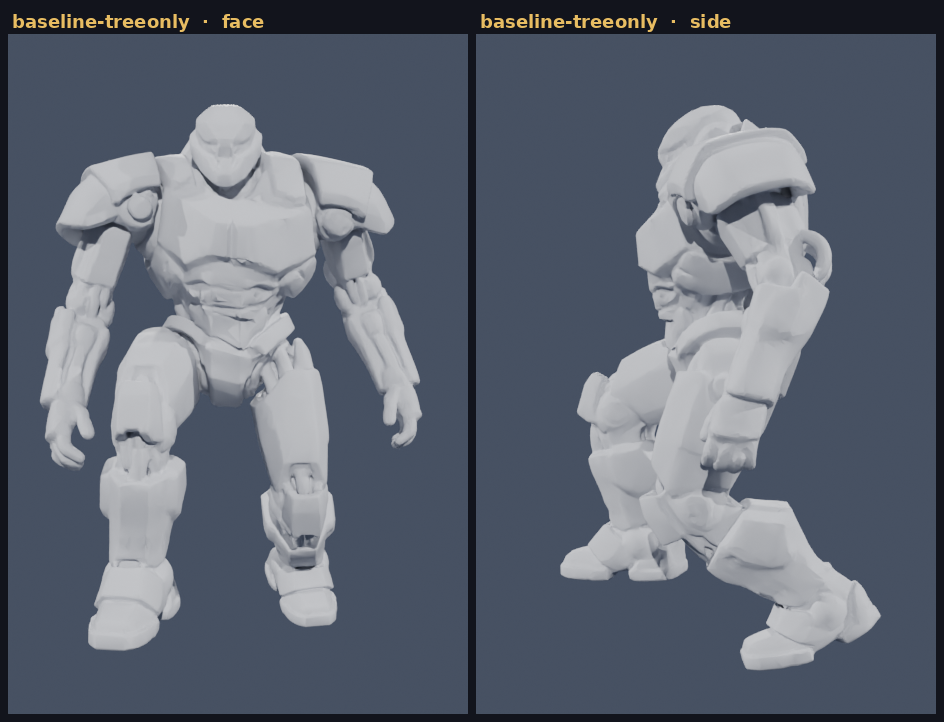
Rigging-technique bake-off — repaired Mech745 and Aegis7
Current review — September 8 UTC: this page always exposes the newest repaired-source candidate for each
active rigging approach. Superseded assets remain in repository evidence and are not rendered here.
The Mech745 candidates use repaired source 7a989041ef71…0bab9999:
59,998 triangles and zero geometric boundary edges after removing one isolated debris triangle.
Both techniques preserve that source identity; their skeletons, weights, and motion differ.
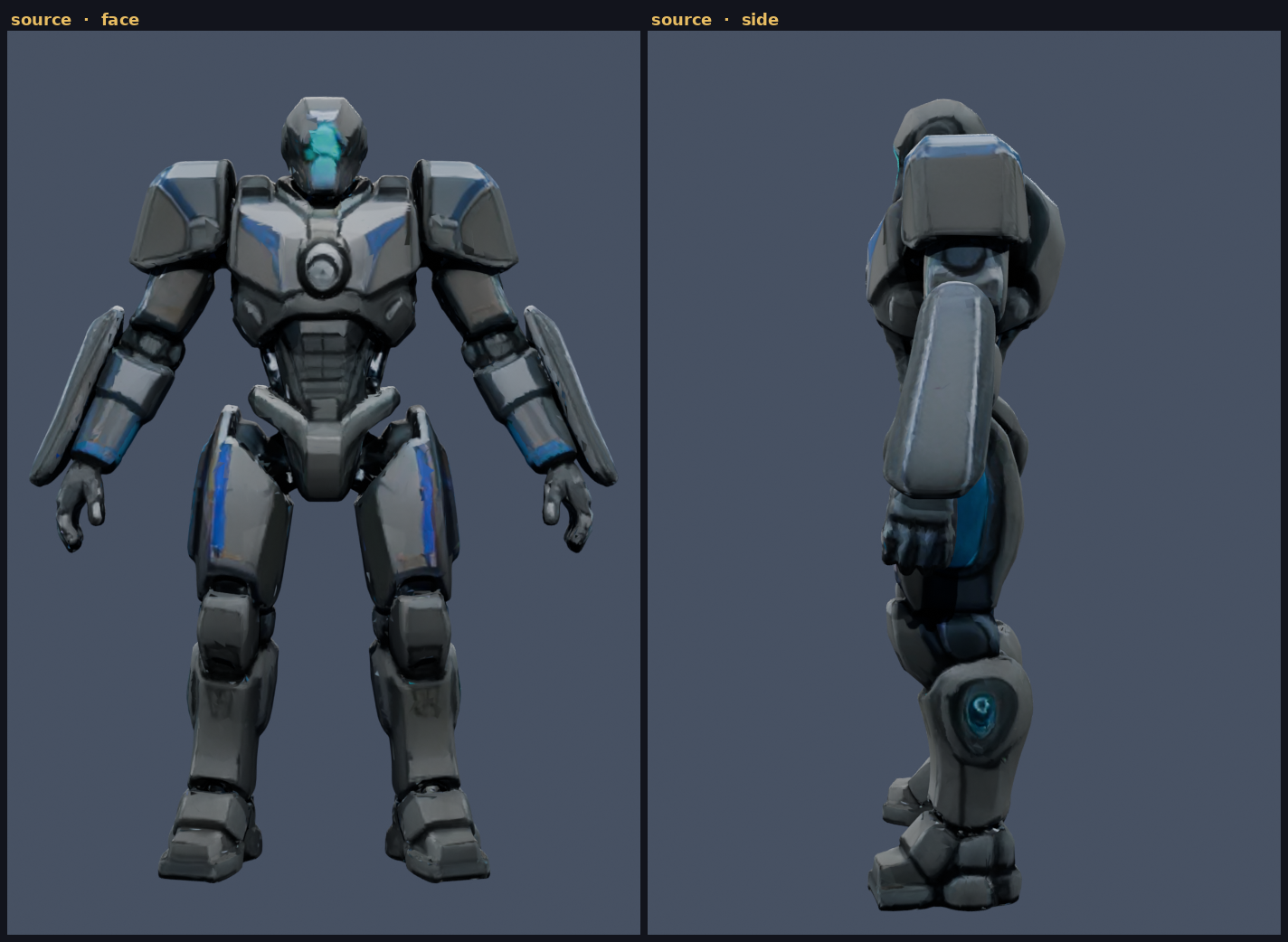
The separate Aegis7 trial uses repaired source 231b8cc311b7…dede2297.
The question a hard-surface mech asks of a rigging technique: do the armor plates stay rigid,
or do they shear/melt when the skeleton moves? Smooth auto-weighting (built for soft
organic skin) blends vertices across plate seams and tears them; a clean DEF-only biped with a
rigid (nearest-bone) skin binds each vertex to one bone, but triangles spanning bones can still stretch.
Automated gate results are evidence labels, not display blockers. A candidate appears here once its GLB
is structurally verified and published; selection and rejection remain separate judgments.
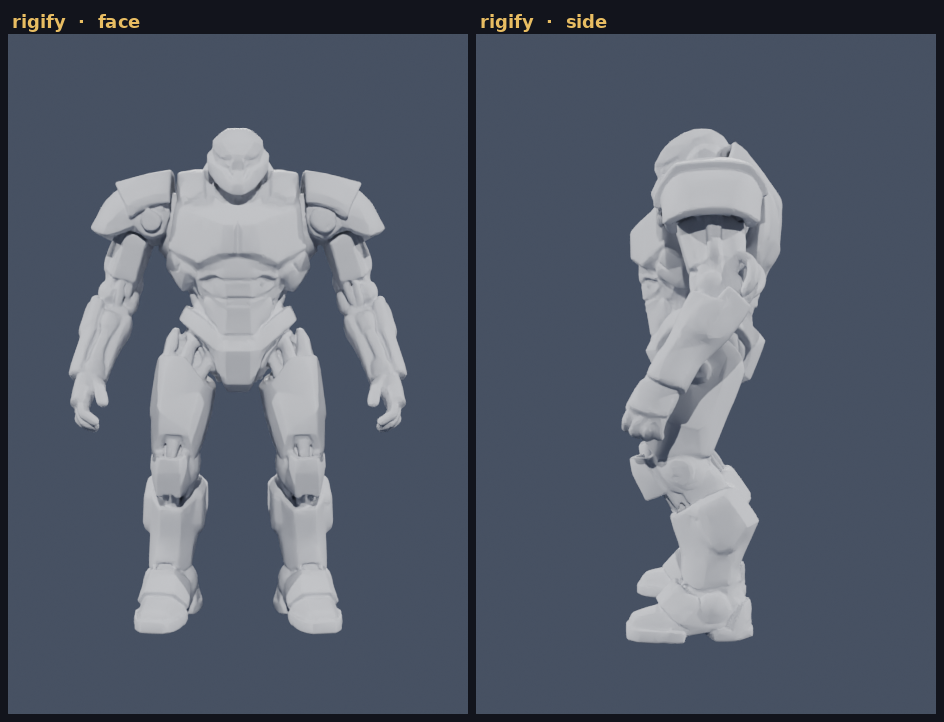
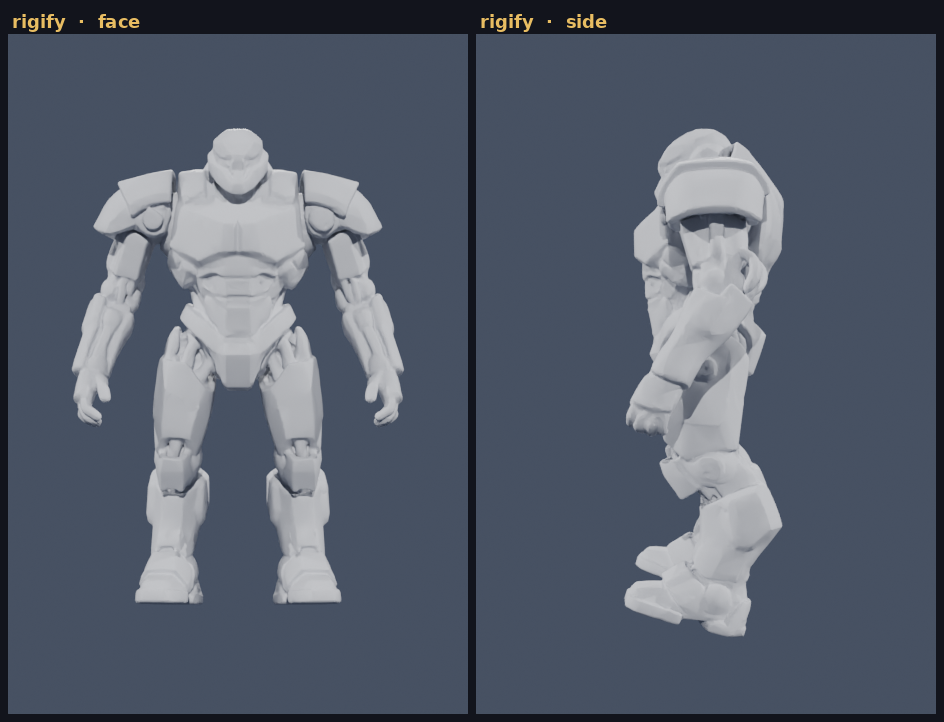
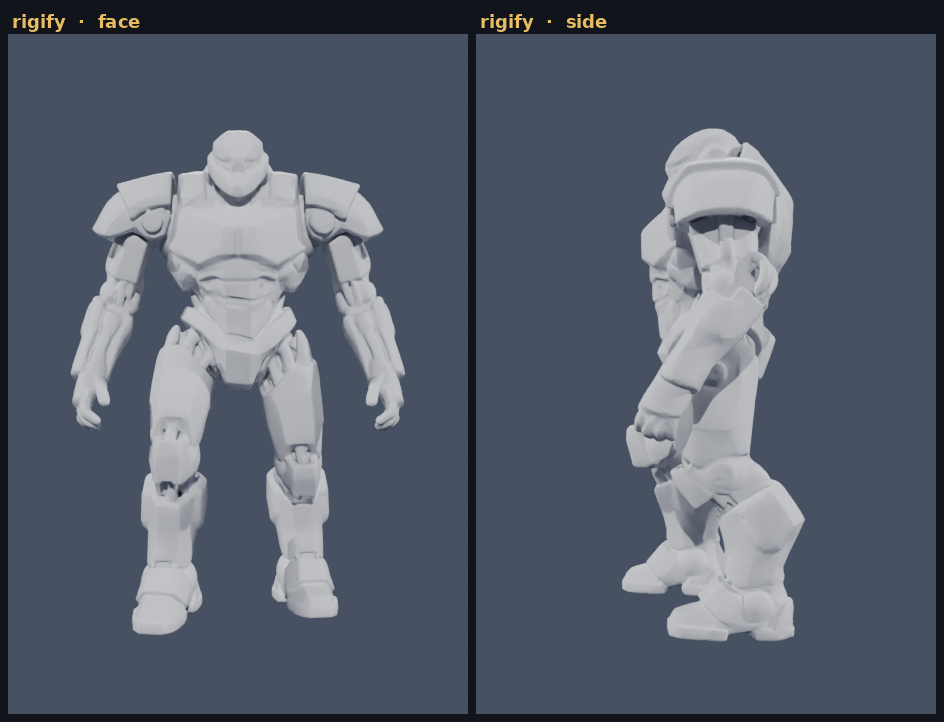
Fresh experiments: Rigify has gameplay-profile Walk/Run plus separate diagnostic leg-pose clips with visible deformation debt.
UniRig now predicts both skeleton and skin weights. Its latest candidate has two controlled leg-pose clips, not an authored gait;
knee and ankle deformation remain visible, and game integration is unfinished.
clip:
UniRig diagnostic pose:
Rigify diagnostic pose:
Aegis7 UniRig diagnostic pose:
Aegis7 Rigify diagnostic pose:
camera:
Repaired mech rig review deck
Selected default · September 8: Rigify is the default approach for custom articulated models, including mechs and future humanoids, with anatomy-specific fitting. A01 has 24 experimental clips, including nine melee and ten ranged trials; A02 has source-fitted arms and inward palms across five clips. Broader rollout, melee repairs, attack chains and ranged poses remain in progress. UniRig remains a comparison option.
The new Rigify action cards have independent controls and share the travel-speed reference below. Matched diagnostic controls remain separate. Mech745 retains its matched source, separate Rigify and UniRig diagnostic controls, and Rigify Walk/Run. Models load automatically as they enter the viewport.
Surface-invalid legacy exports are not mixed into this current-source deck.
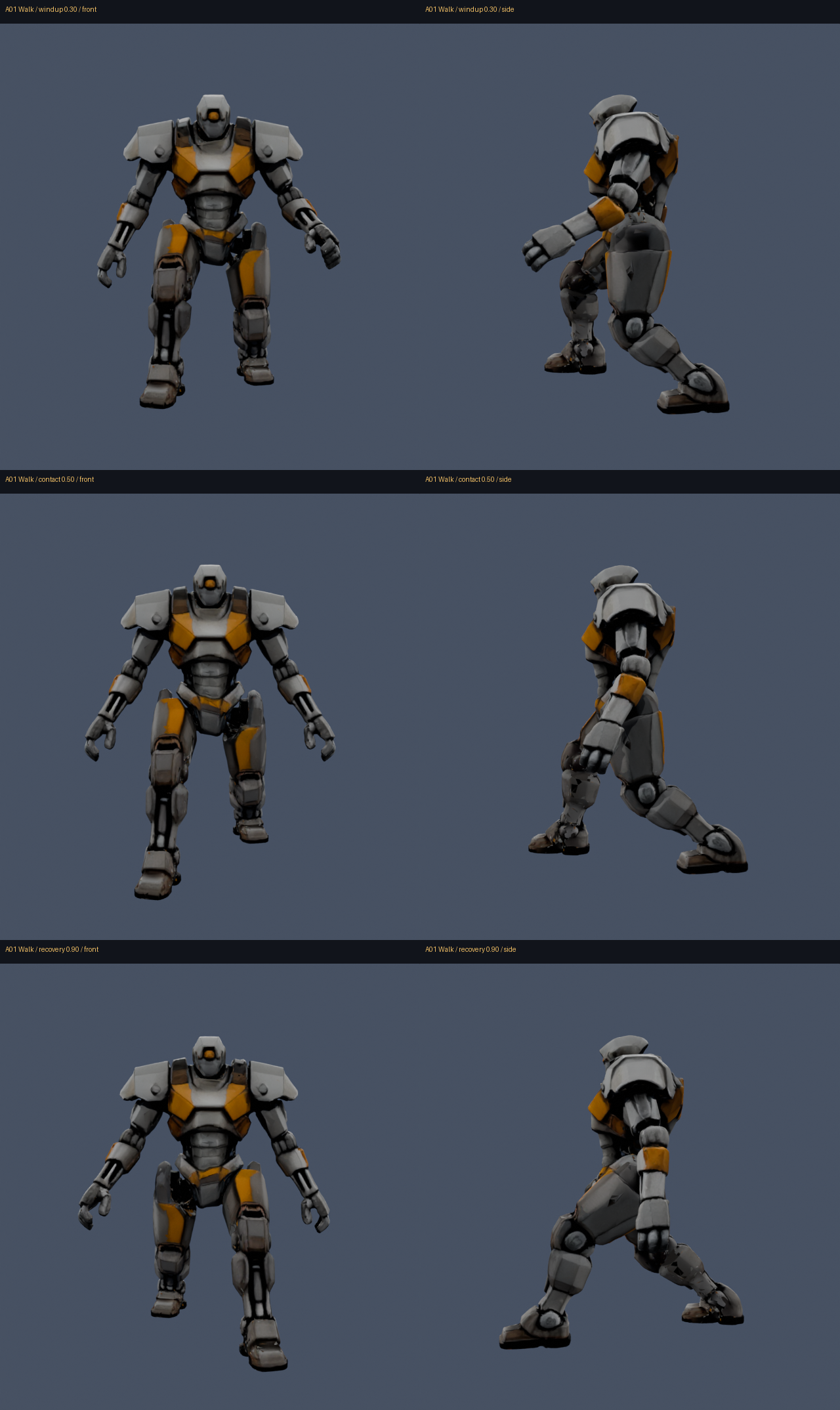
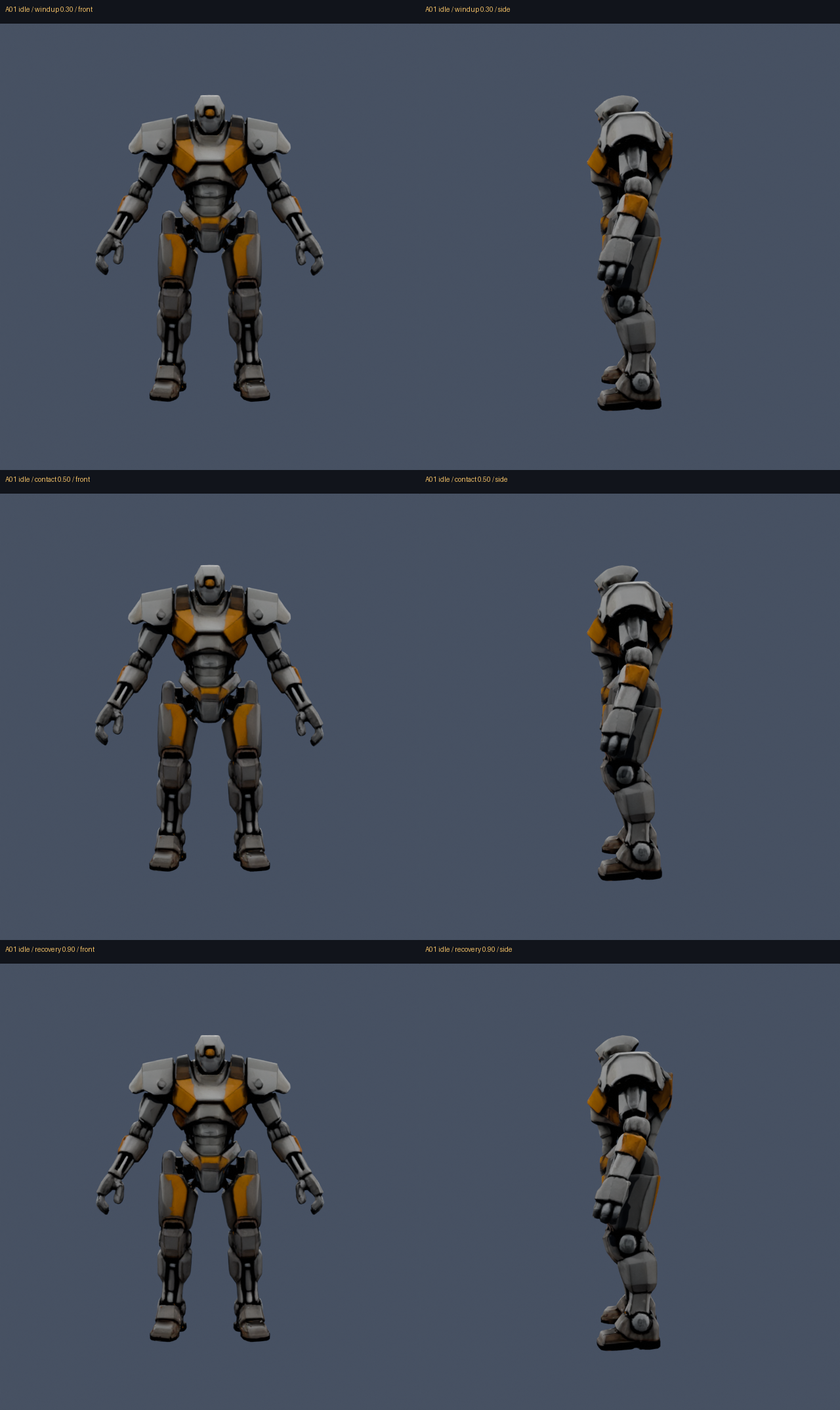
Source-fitted Rigify + corrected armor ownership · repaired A01 source · 59,998 triangles · 29 reachable deform joints · Walk / Run / idle / dodge / slide.
Open latest A01 Rigify GLB ·
Open repaired A01 source
Cadence = travel speed ÷ authored speed (Walk 4 m/s; Run 7.2 m/s). Default Walk is 0.5×, representing 2 m/s.
This stationary viewer simulates travel speed; gameplay uses measured movement. Agility currently affects dodge, not normal walk speed. Non-locomotion actions retain their authored timing.
Anatomy repair: measured shoulder/elbow/wrist fitting, rigid chest and shoulder-cap ownership, neutral attack wrists and independent attacking/guard arms. Nine-melee chest width remains 1.00000022× its starting width, versus 1.42× previously. Maximum internal chest-edge strain is 0.00475%.
Runtime verified: the actual A01 roster loader selects this exact export; all 24 native actions select and advance or complete their expected one-shot duration. This does not yet verify equipped attacks, input-driven chains or full on-foot combat.
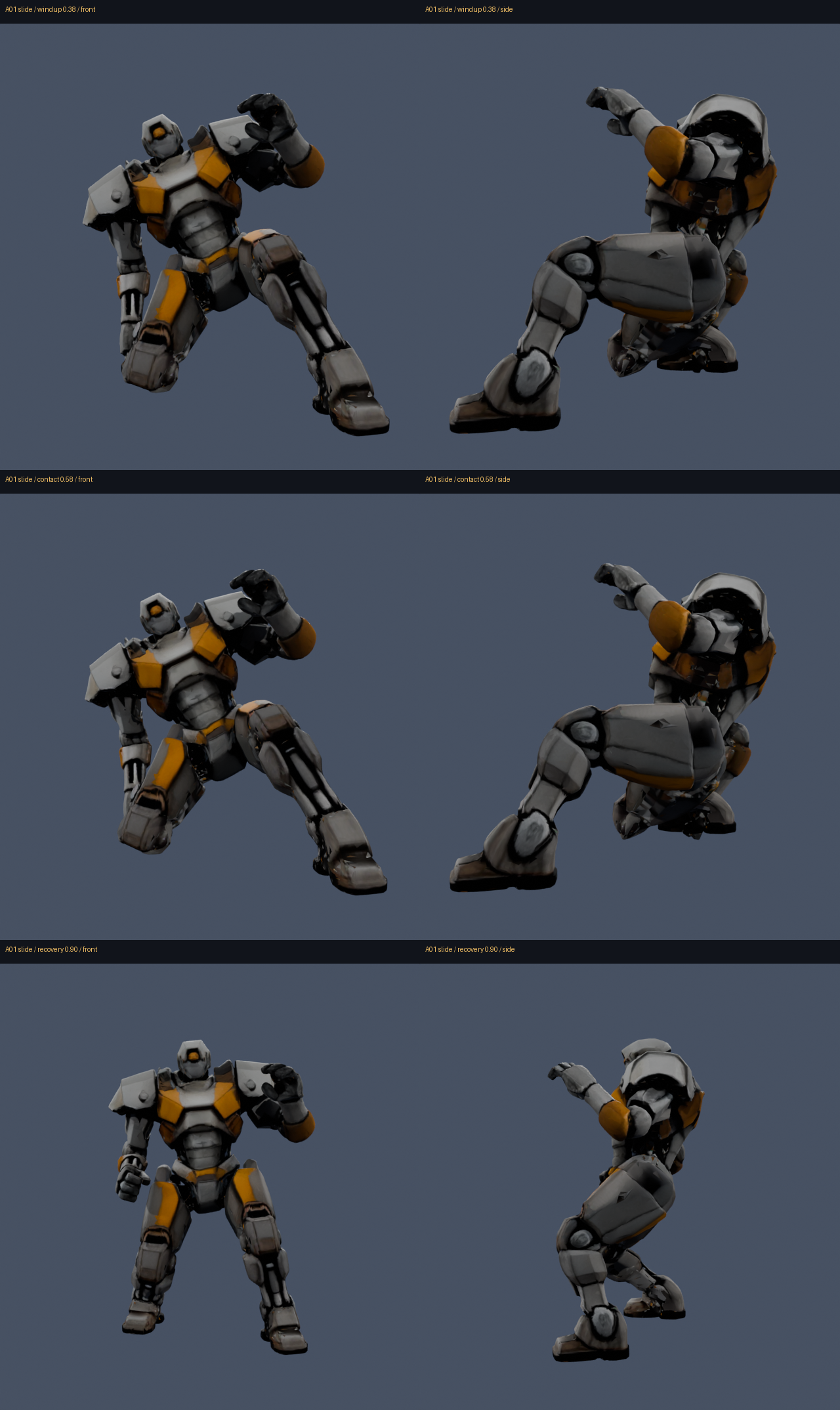
Remaining defects: collar and lower-body seams remain visible; deep slide poses shear hip/thigh armor and the lead knee is not extended like the concept target. Strict Walk export drift remains 0.8301 mm / 0.1133° and gait seam checks fail. No tolerance was relaxed.
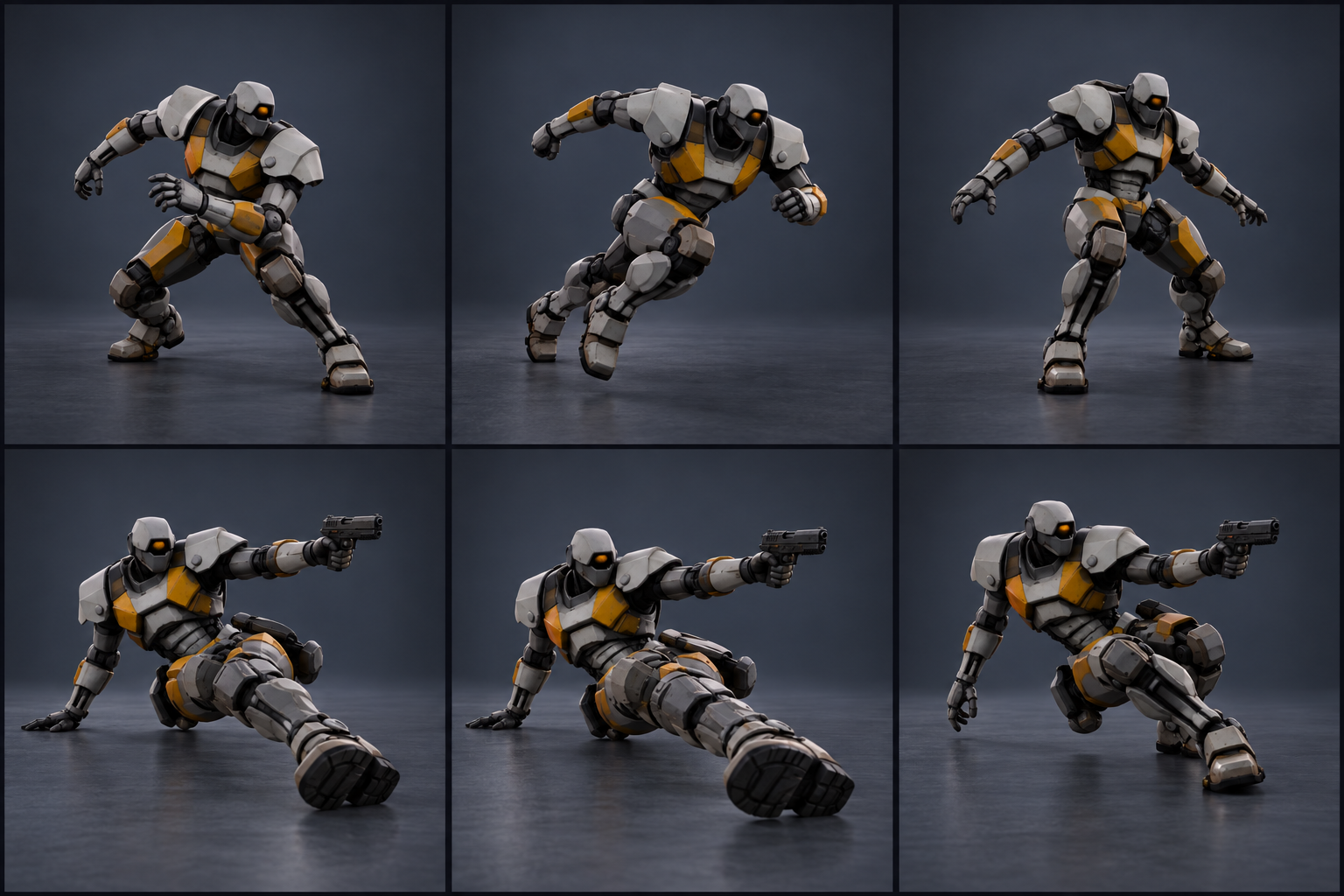
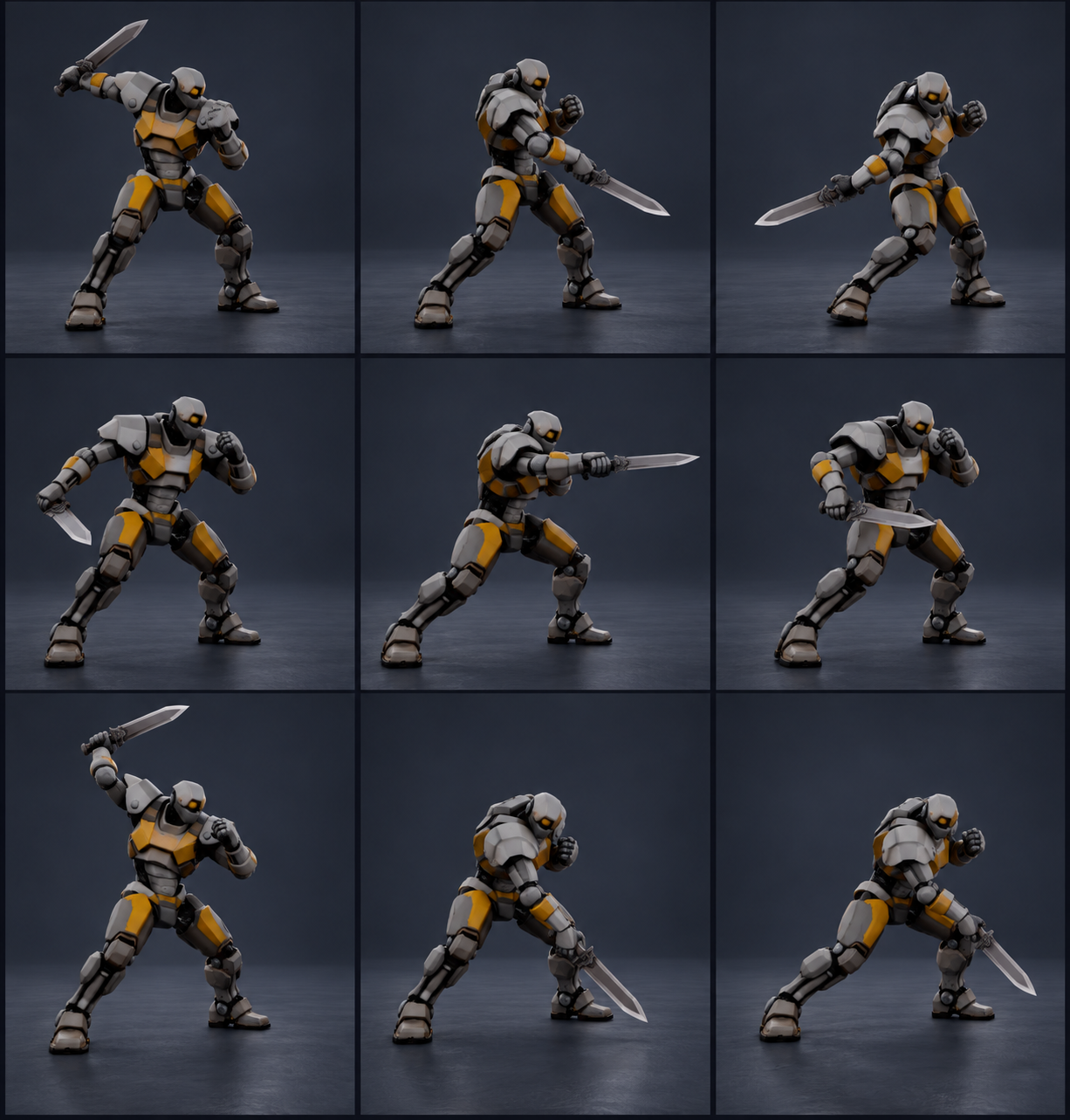
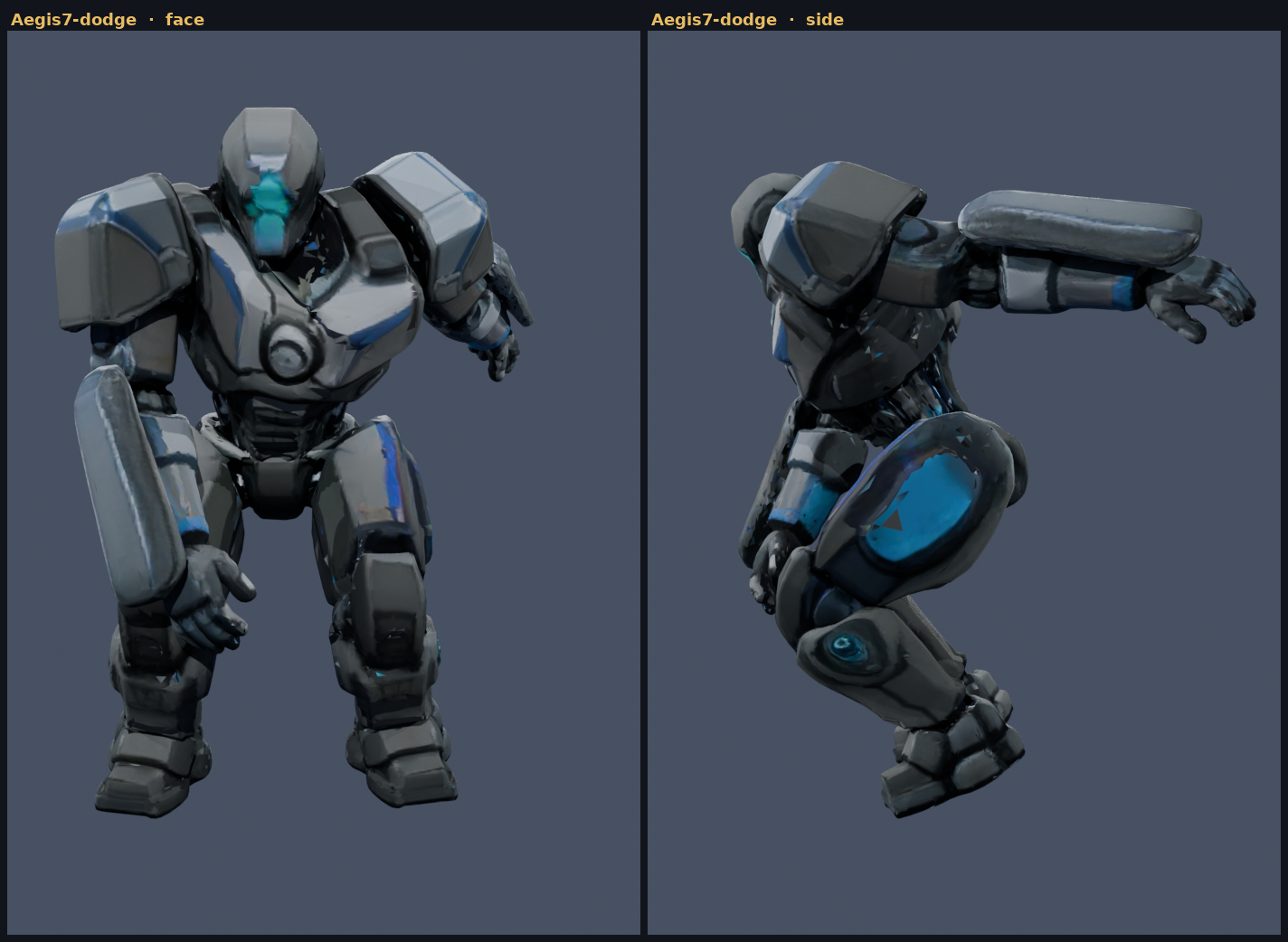
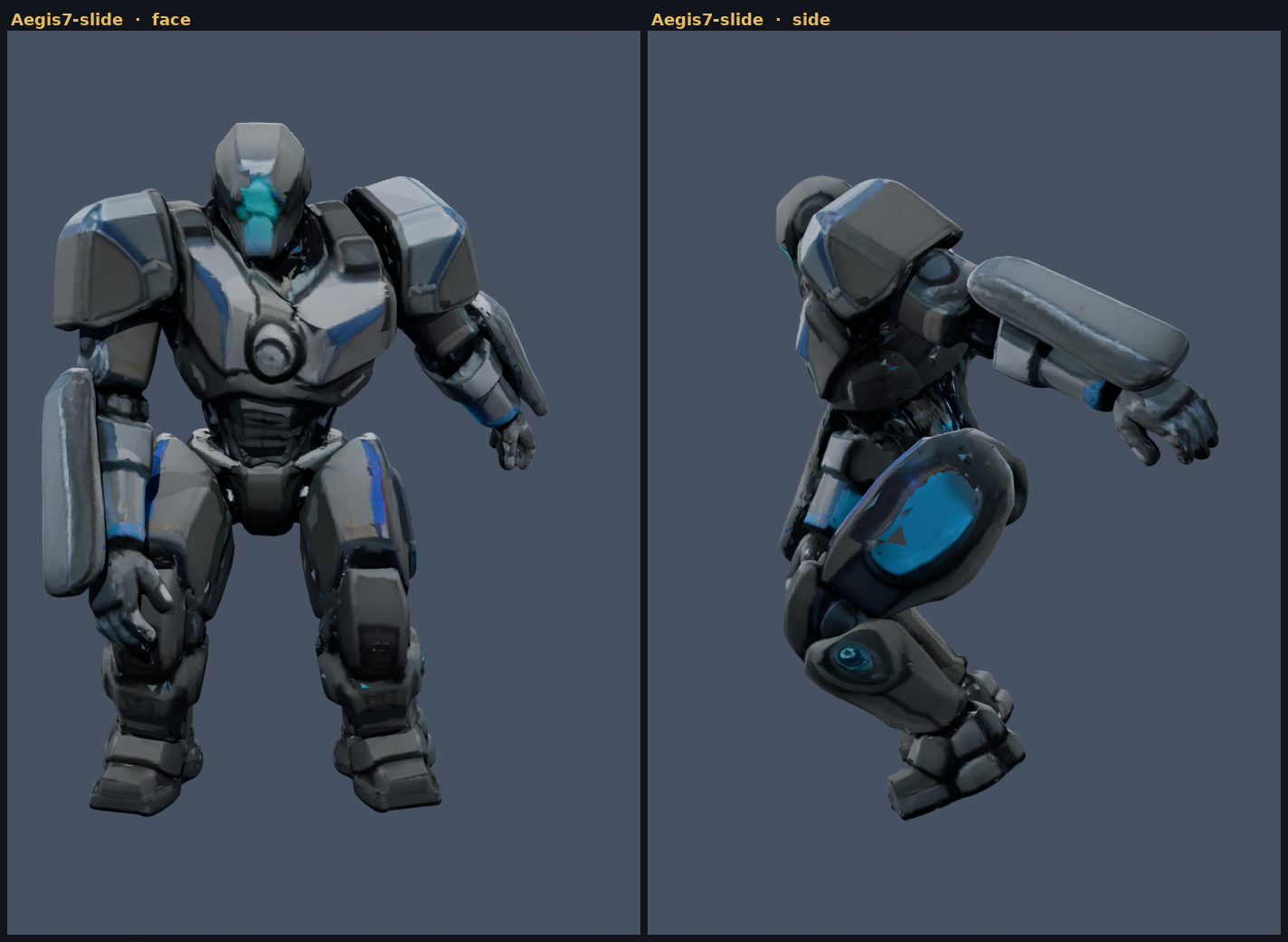
Slash, stab and bash each have two light trials and one heavy trial, now with a distinct lead arm and guard. Ten pistol/rifle aim/fire clips are present, but weapon fixtures, grip/aim alignment and attack chains remain unfinished. Dodge is a low directional lean; slide is asymmetric but still short of its approved target.
Combat timing update: the latest file adds all nine melee contact markers without changing geometry, skin or pose curves. Tagged light attacks now follow gameplay recovery/contact timing; this browser still shows authored timing. Untagged golden-body playback is unchanged.
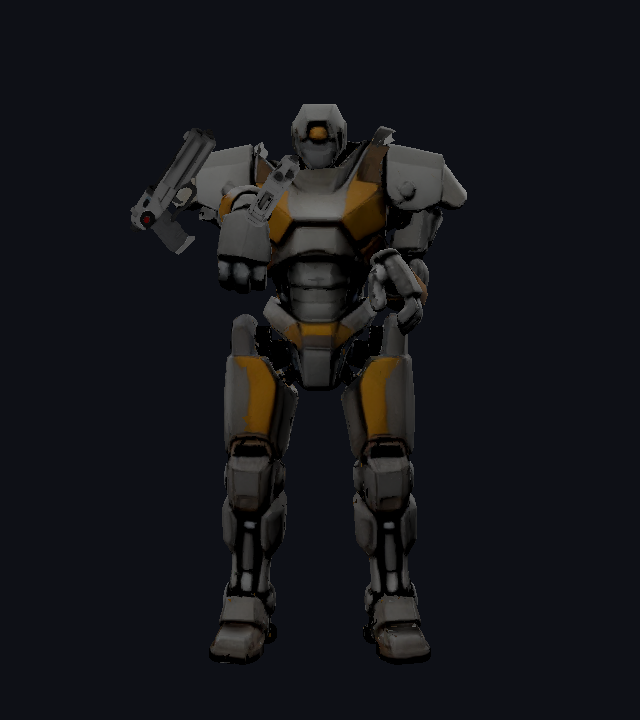
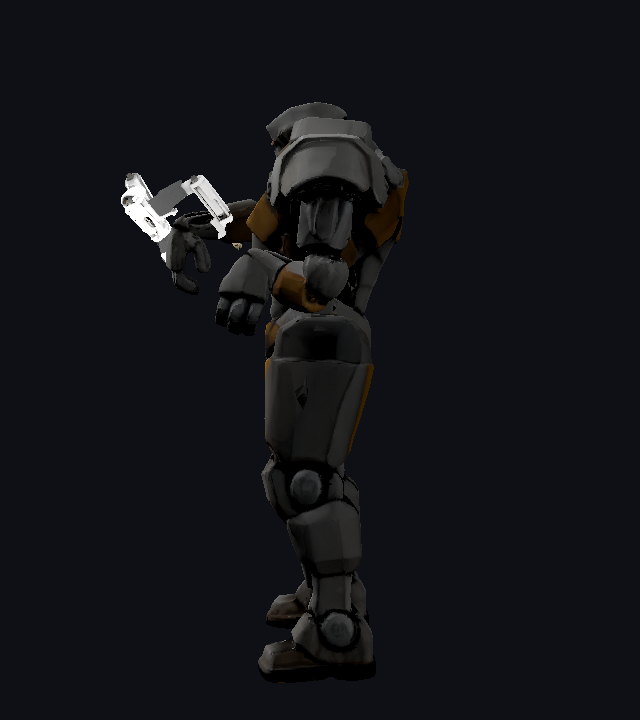
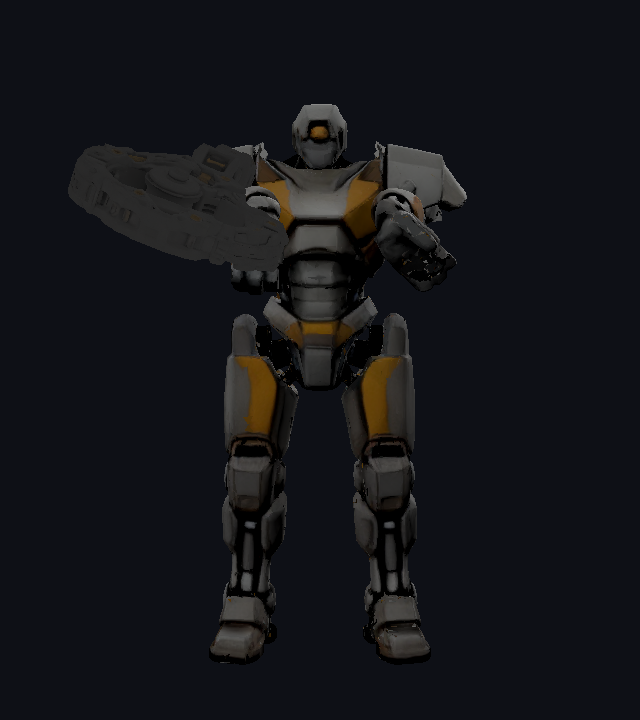
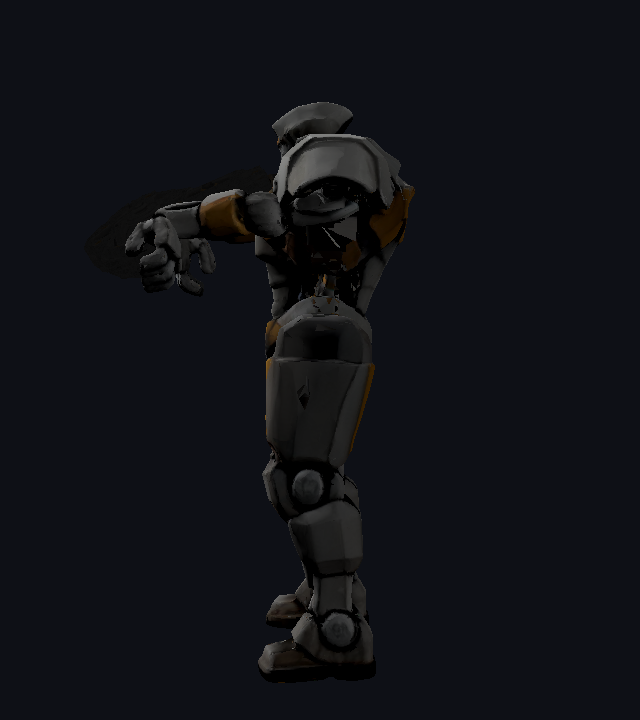
Equipped runtime evidence: Rigify hand attachments now resolve, but grips are not accepted. Pistol aim is off the target line; the rifle is unshouldered and lacks support-hand contact. Actual model renders:
pistol front · pistol side · rifle front · rifle side.
Pistol · frontPistol · sideRifle · frontRifle · side
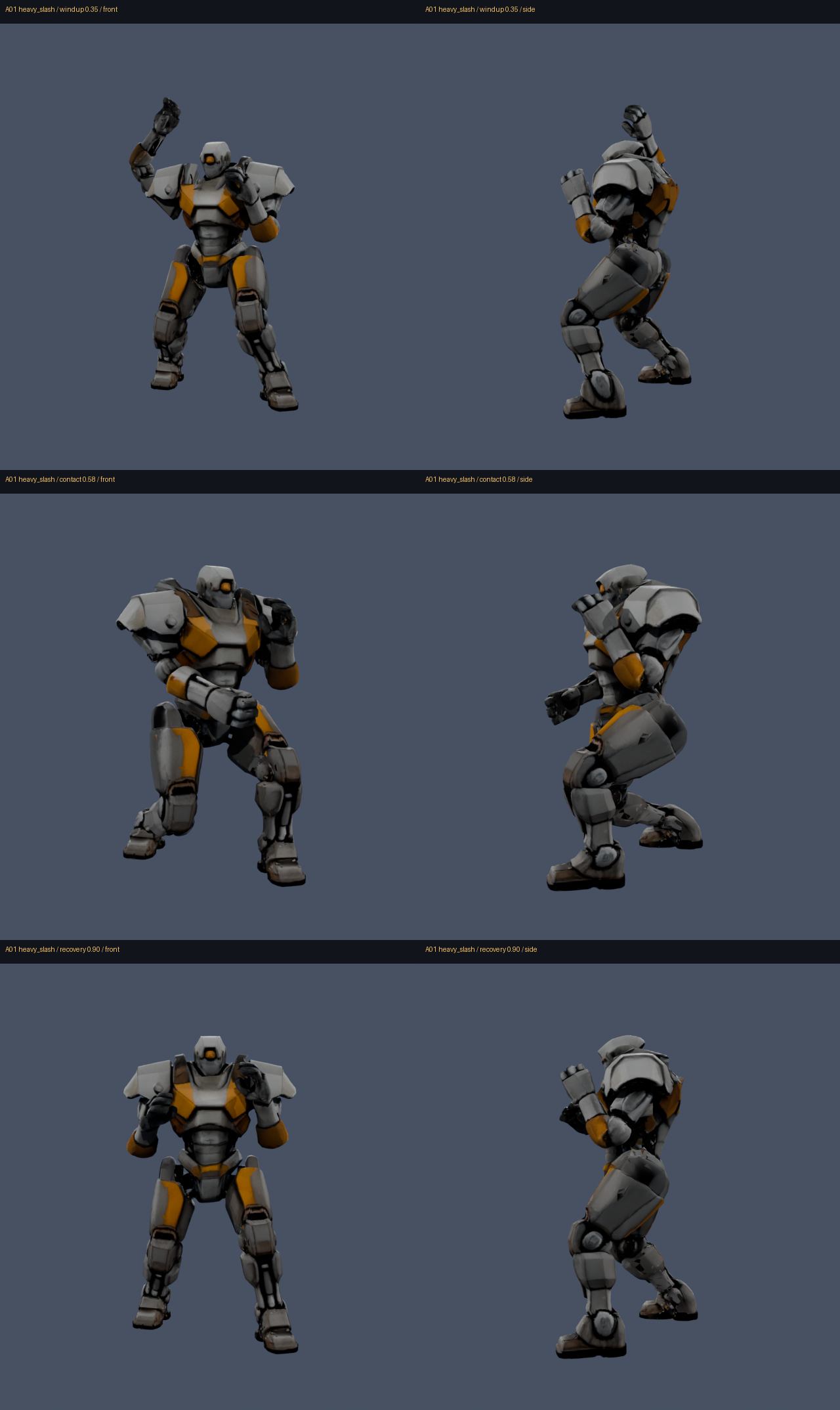
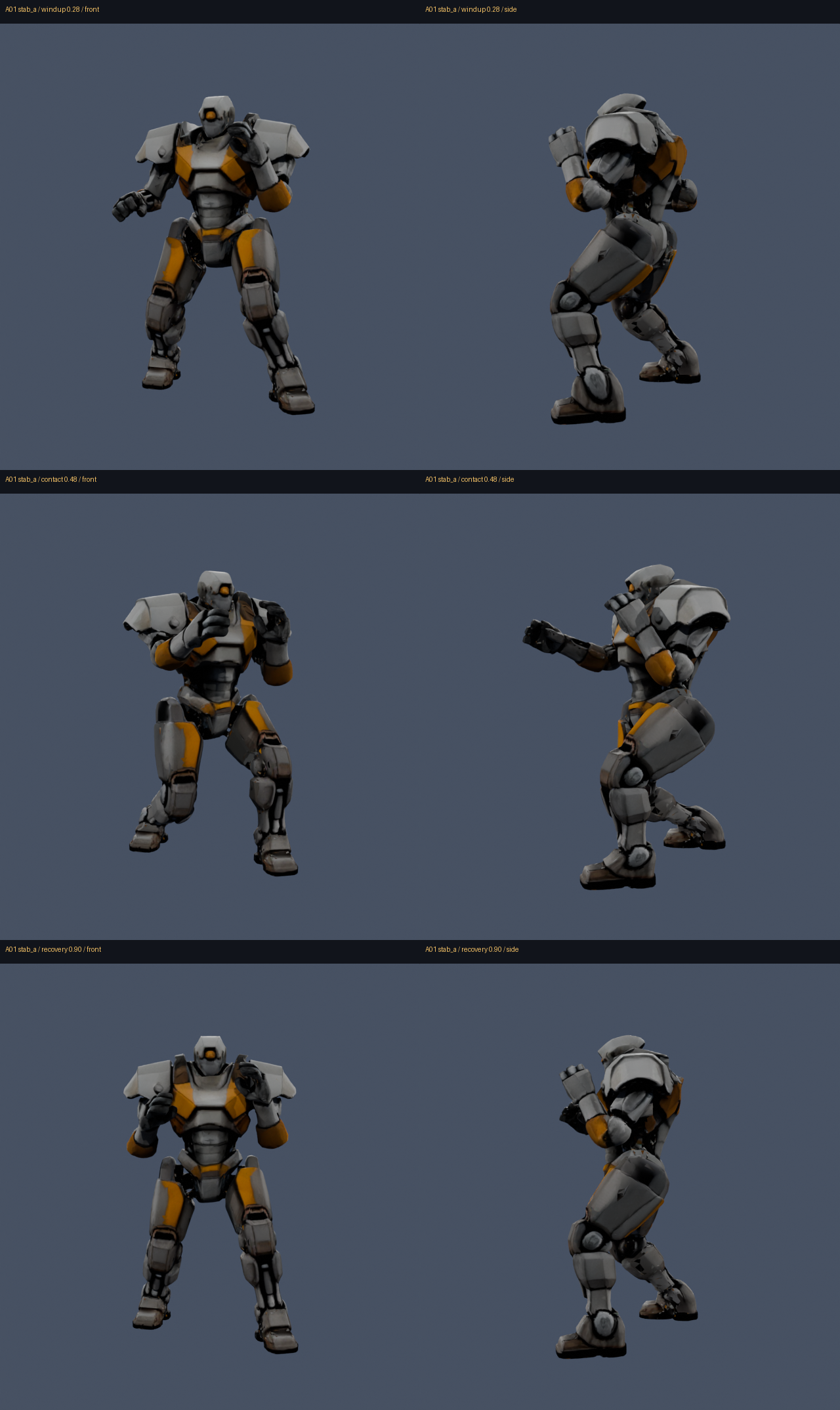
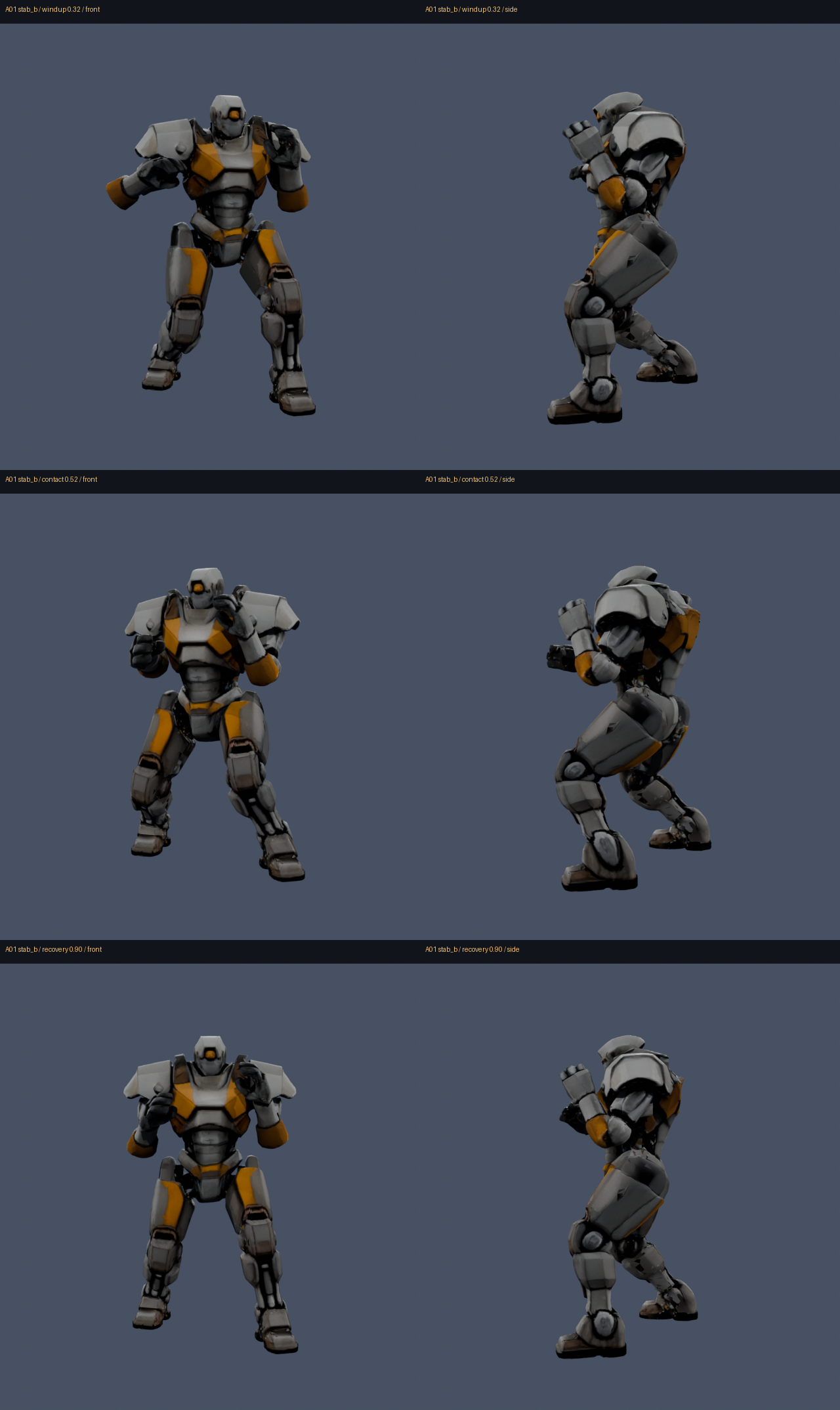
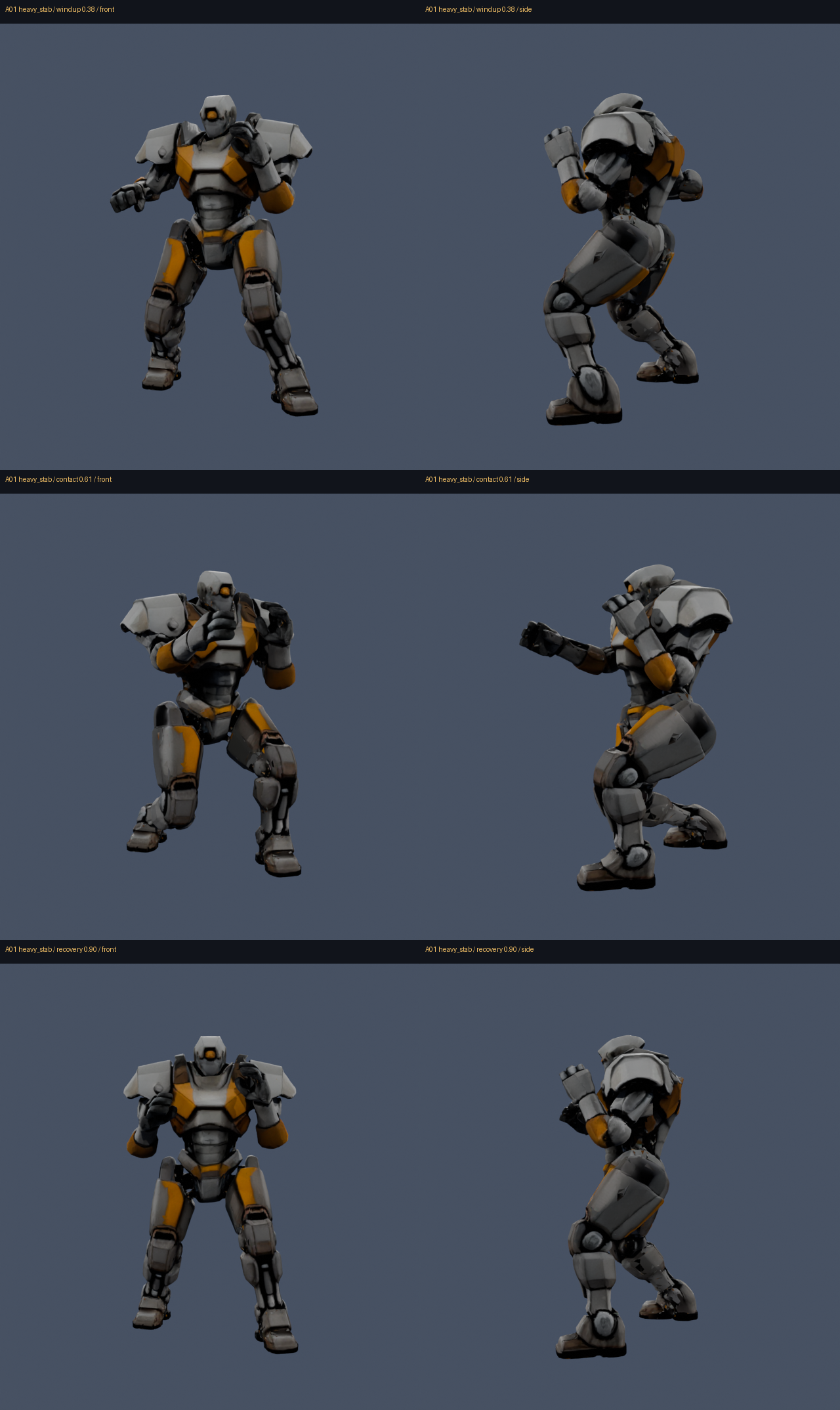
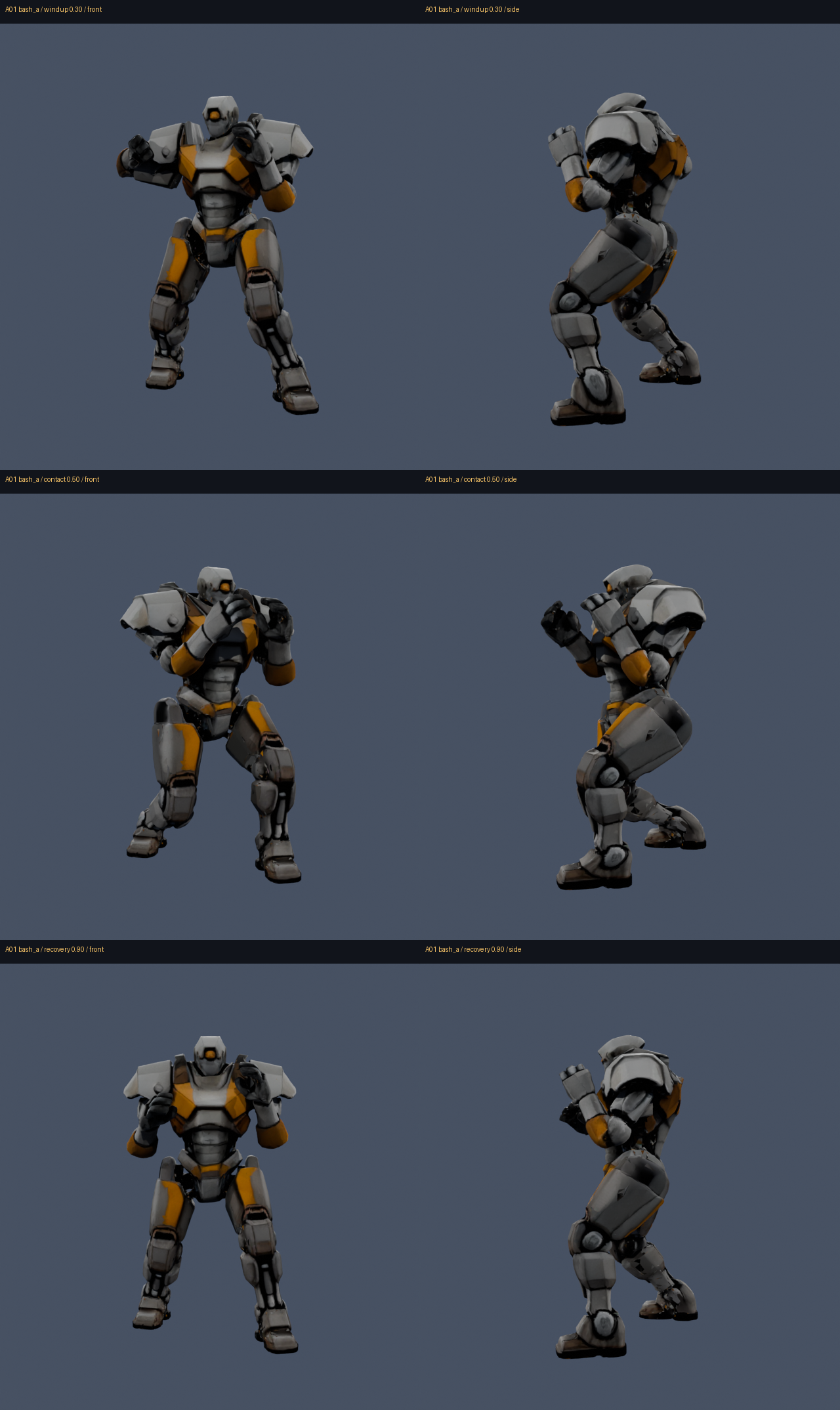
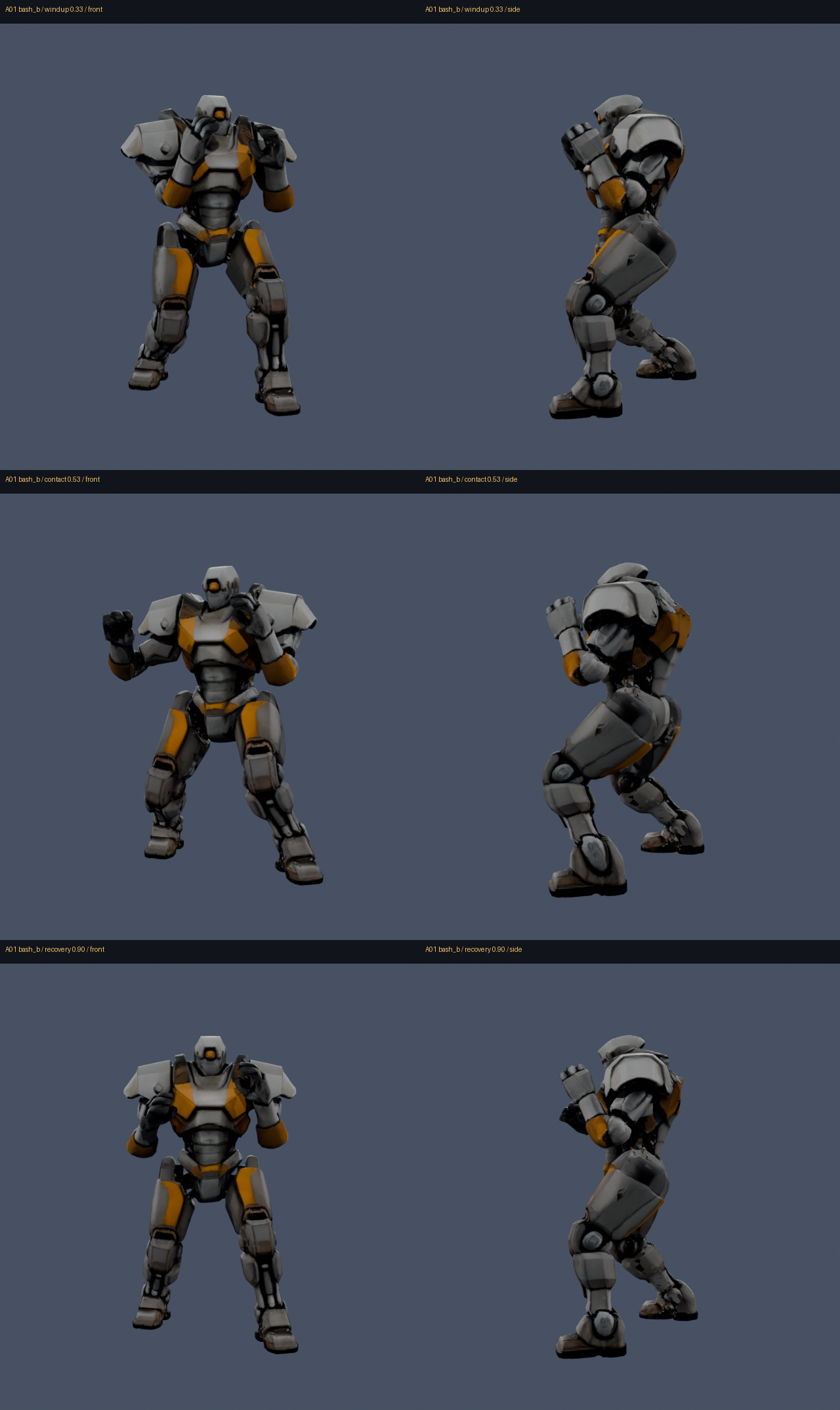
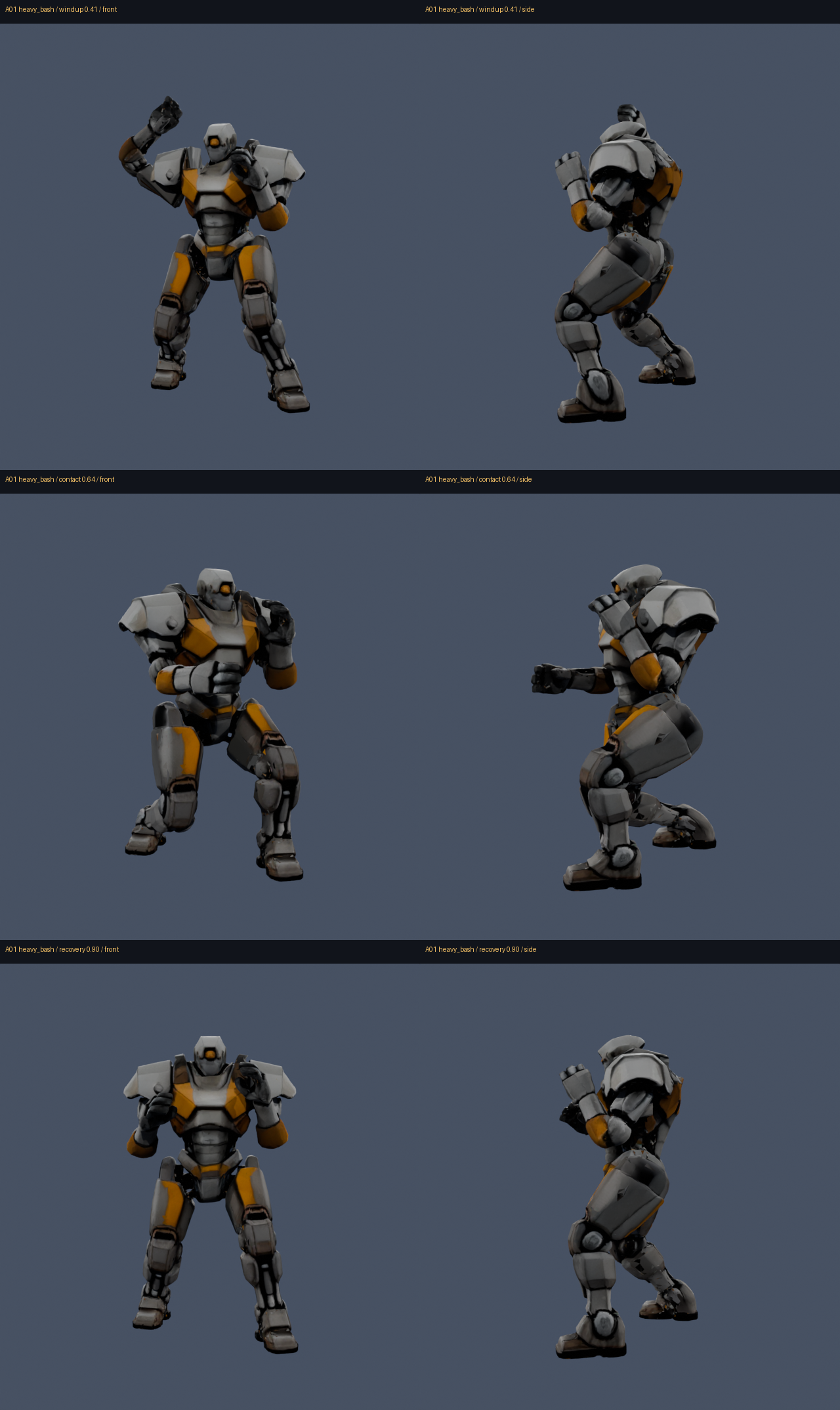
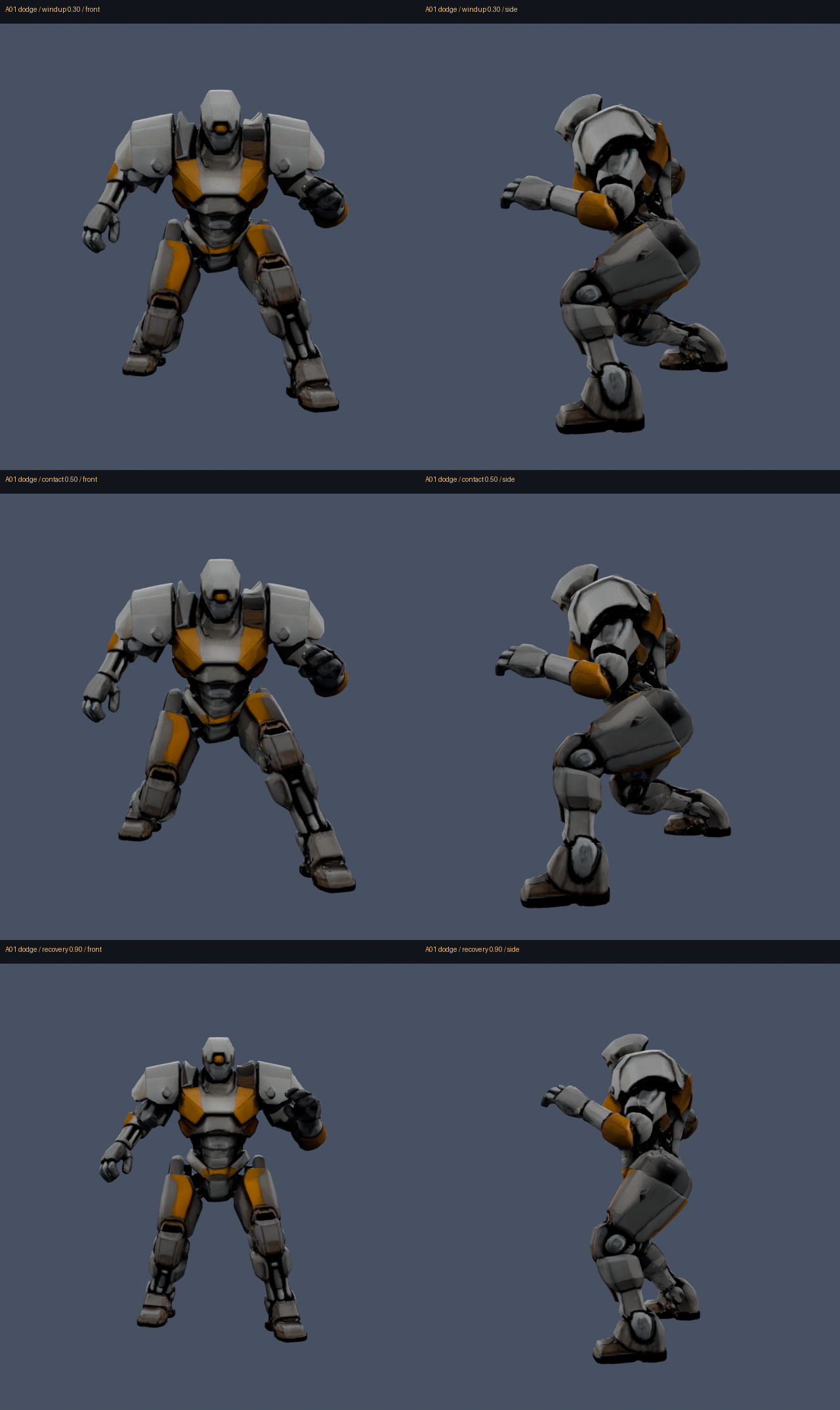
User-approved visual gold standard. These AI-generated targets guide rig corrections; they are not renders of the current animations. Compare pose, silhouette, guard arm and rigid armor, then review continuous motion.
Dodge and slide: anticipation → peak → recovery.Slash, stab and overhead strike: windup → contact → recovery. Current GLBs still need to match these targets.
Fresh Rigify controls + automatic weights · manifest-pinned closed A02 source · 29 reachable deform joints · Walk / Run / idle / dodge / slide.
Open latest A02 GLB ·
Open static source
Uses the shared travel-speed reference above, initially 2 m/s. All five clips load with normalized skin weights. Strict controls/export comparison still fails (0.927 mm / 0.152° hand drift); both gaits retain seam-velocity defects. Hip/thigh deformation remains unresolved. Dodge and slide still need the newly specified dash and asymmetric slide poses; full melee/ranged coverage and gameplay acceptance are pending.
Anatomical arm and palm correction: source-specific shoulder, elbow and wrist landmarks now fit before Rigify generation and automatic weighting. Actual palm surfaces face inward with neutral wrists across 25 sampled phases of all five exported clips. Both elbows flex 20–45° in Walk and 50–90° in Run. The source's outward arm stance is retained; this is not a new arms-down idle.
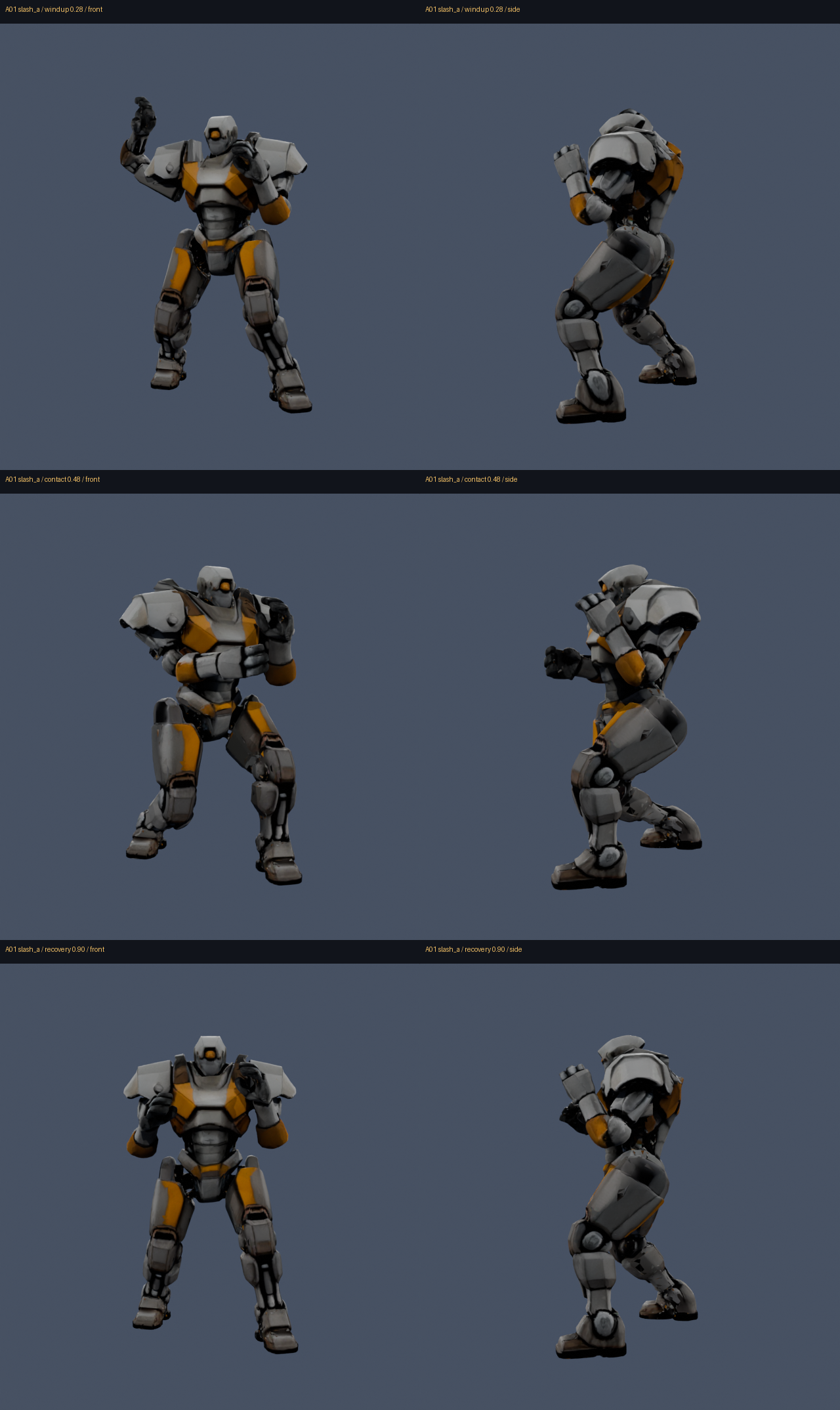
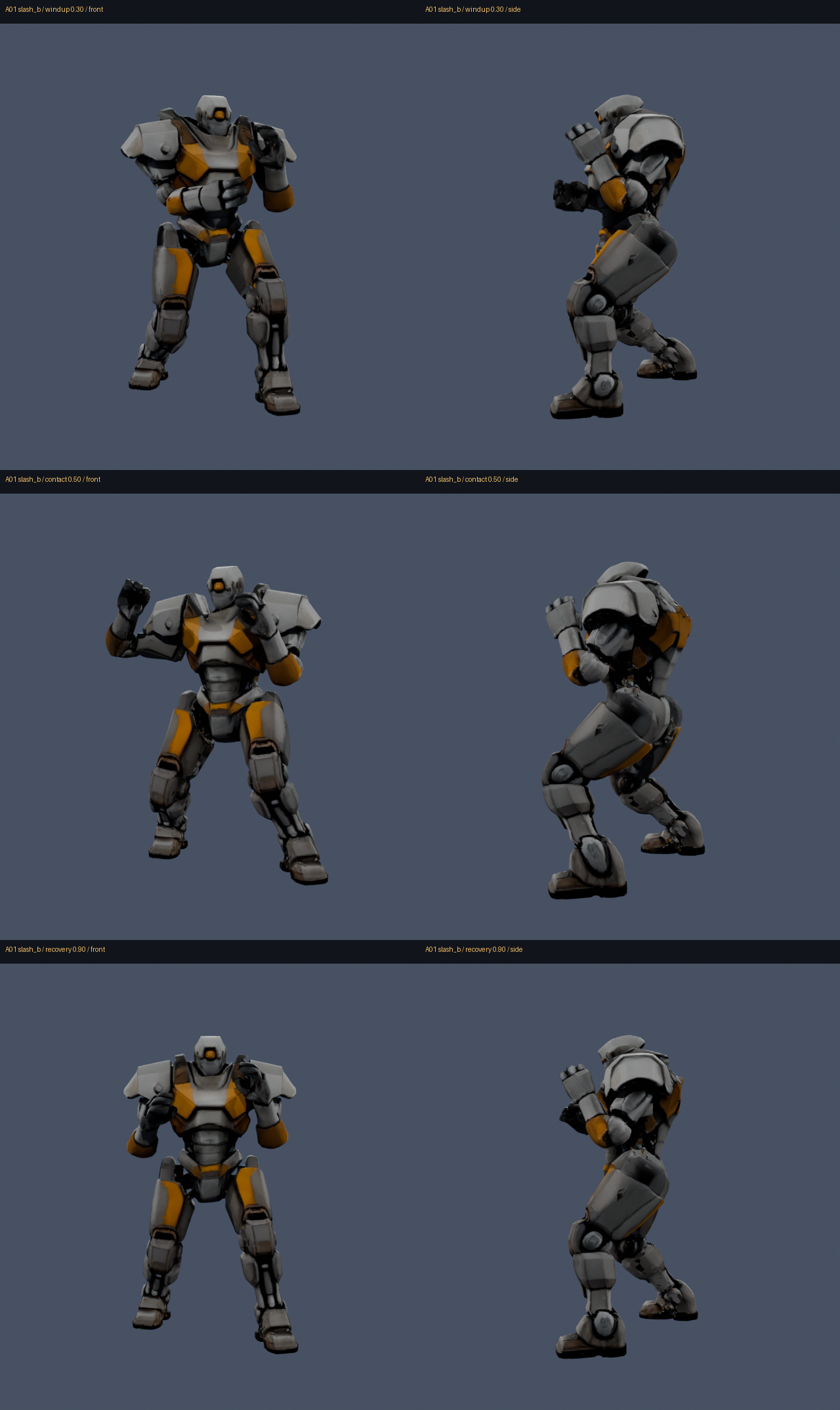
Current candidate 341080f8b8a6: ten pistol/rifle aim and fire clips are appended to the preserved 14-action heavy-slash trial. Ranged review shows drooping firing wrists, a folded rifle support wrist and open hands; there are no finger chains or weapon fixtures. These are rejected pose-only trials, not usable weapon holds or rollout approval. The inherited heavy slash still has mismatched open palms at contact; other melee attacks and full chains remain unrefined.
Concept and actual three-phase review below · The retained sheet covers inherited heavy slash only, not the new ranged poses. Runtime selection remains unchanged; this card exposes the latest experimental GLB.
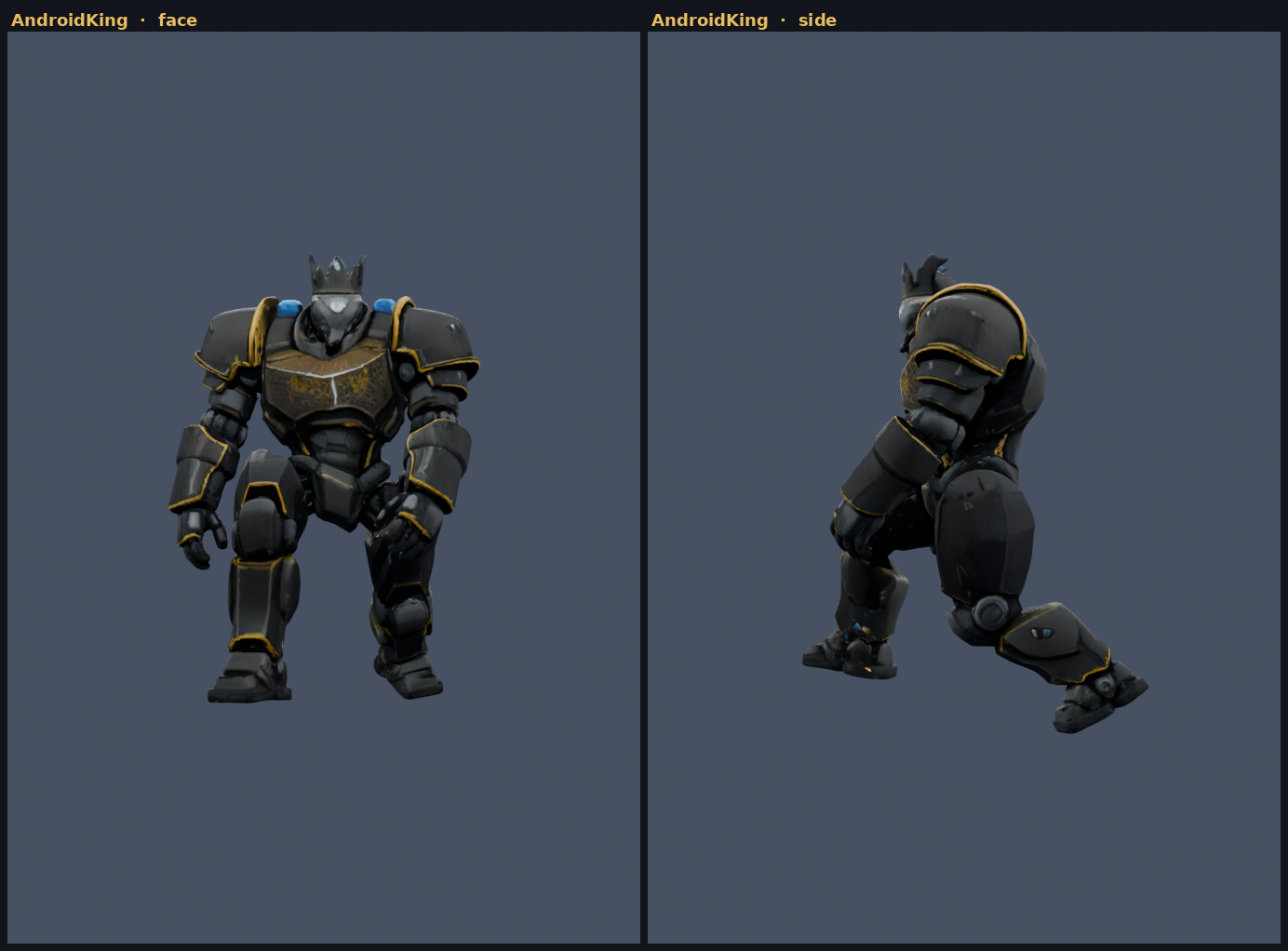
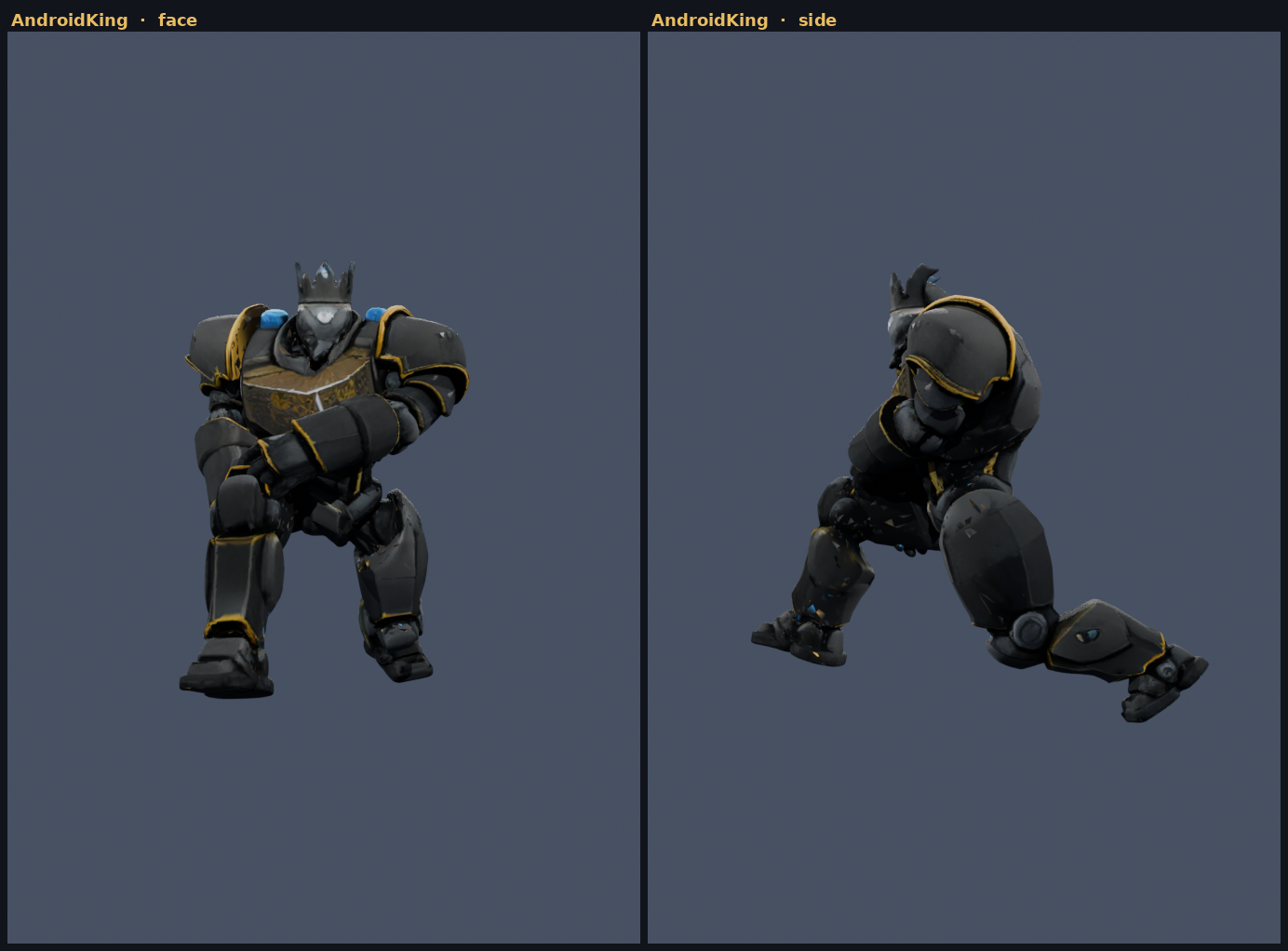
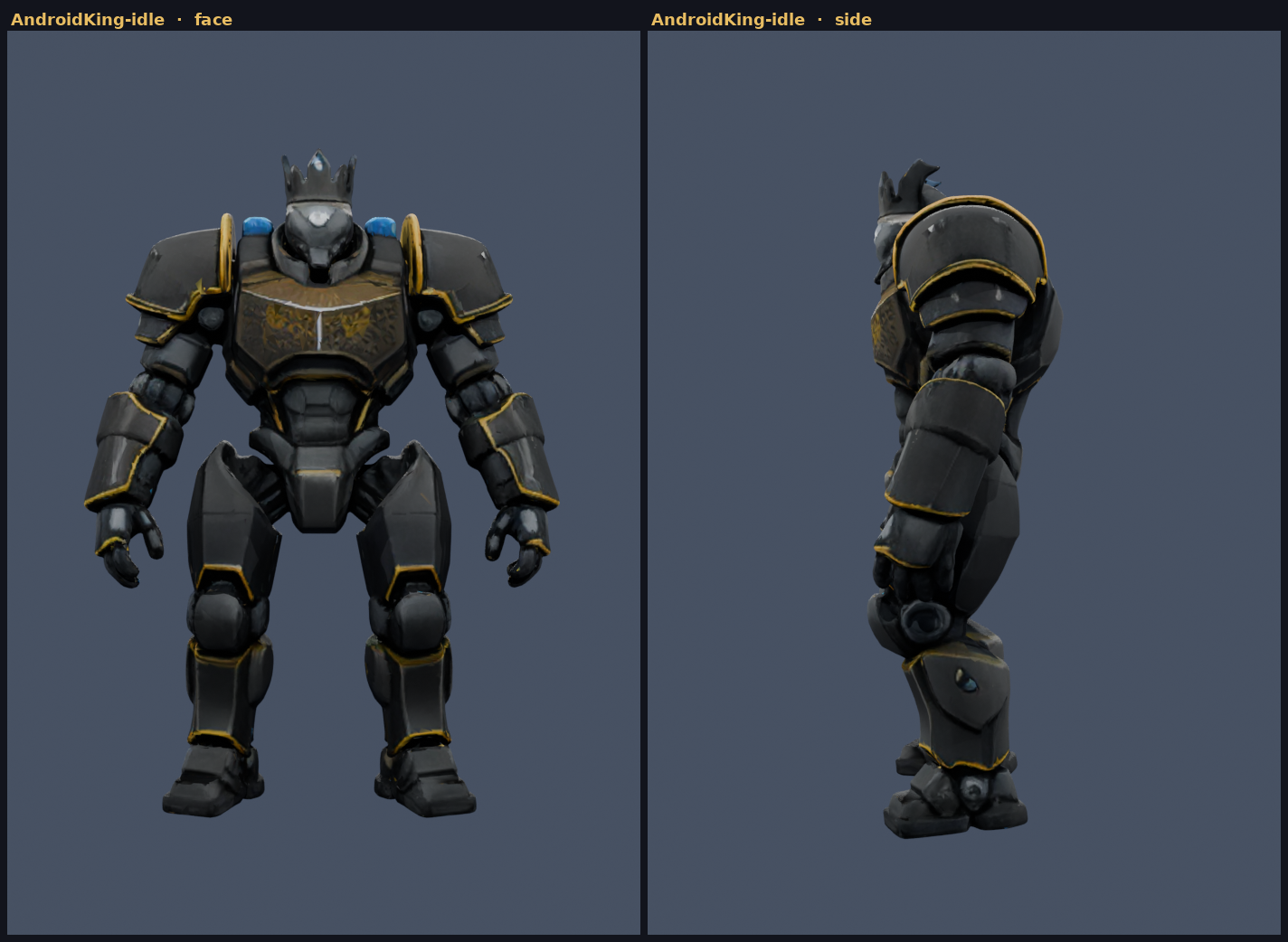
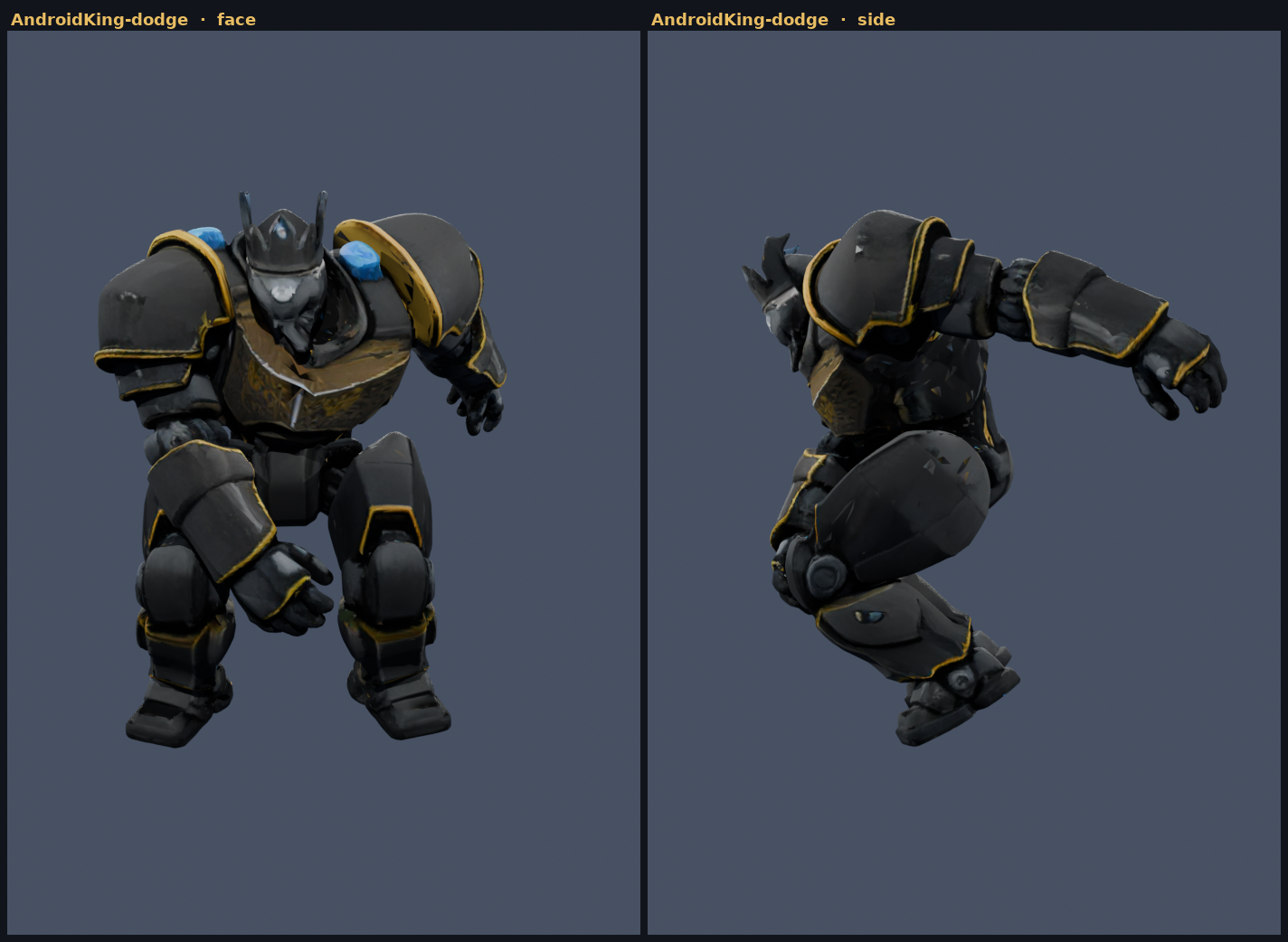
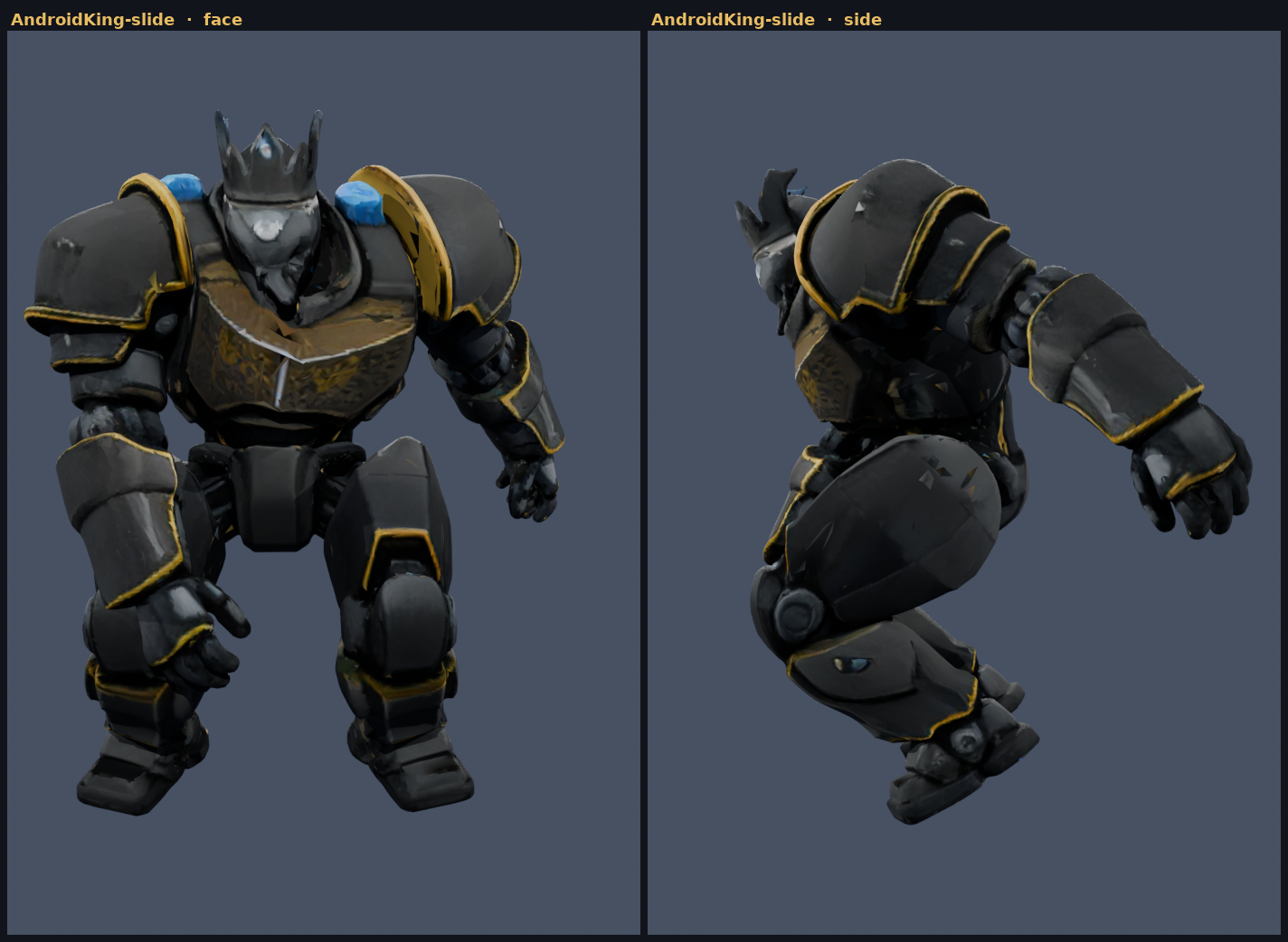
Fresh Rigify controls + automatic weights · repaired Android King source · 29 reachable deform joints · Walk / Run / idle / dodge / slide.
Open latest Android King GLB
Runtime roster verification: this exact export now loads for Android King and all five native actions select and advance. Full combat-input and deformation acceptance remain pending.
Corrected bilateral elbow flexion: Walk 20–45°, Run 50–90°. Wrist fit and forearm/torso overlap remain unfinished. Current evidence: Walk · Run.
Uses the shared travel-speed reference above, initially 2 m/s. Export/reimport skin and motion checks pass; locomotion retains a loop-seam velocity warning. Neck/hip tearing remains visible. Dodge and slide are similar crouch trials. Full melee/ranged coverage and gameplay acceptance remain pending.
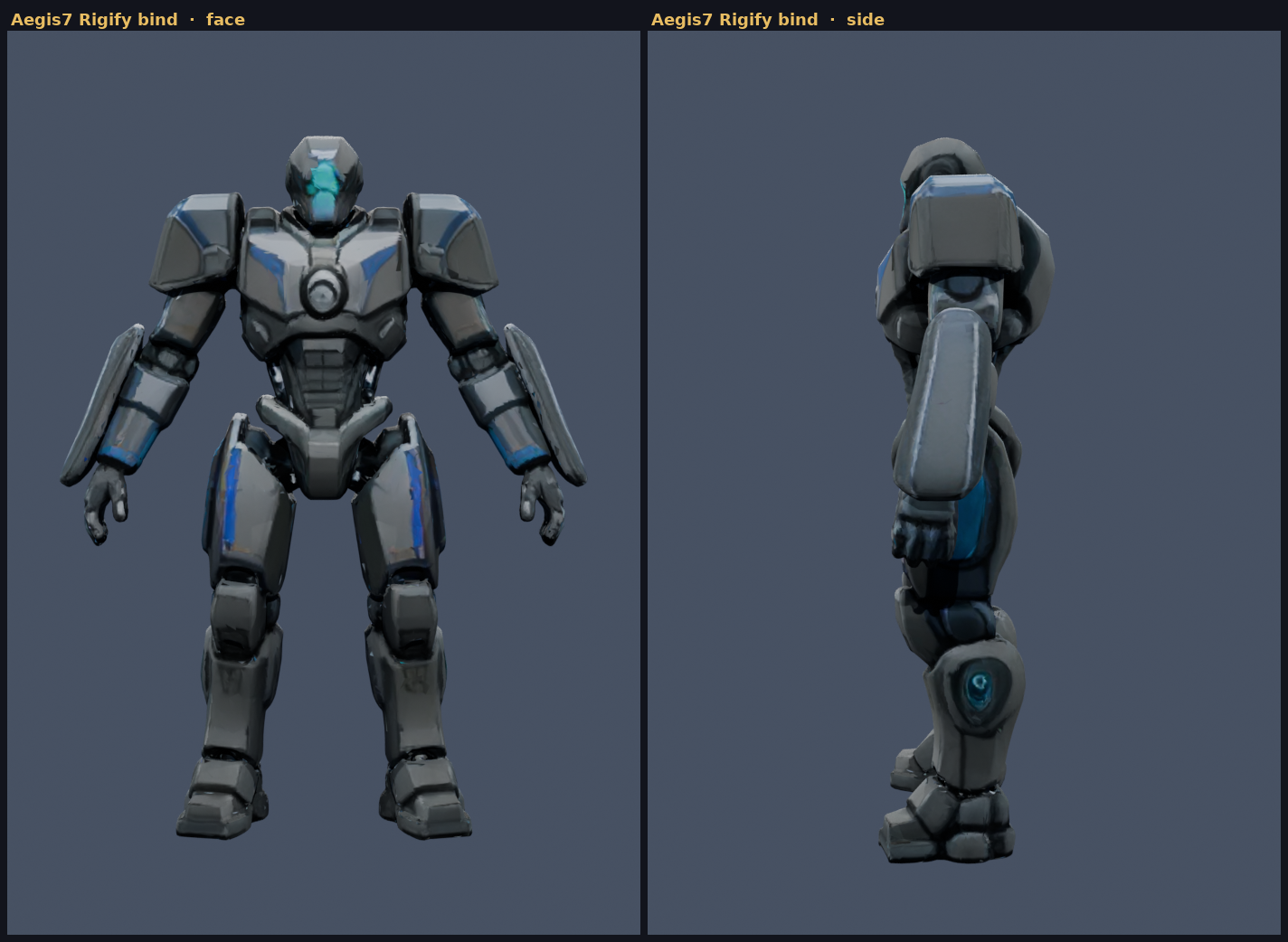
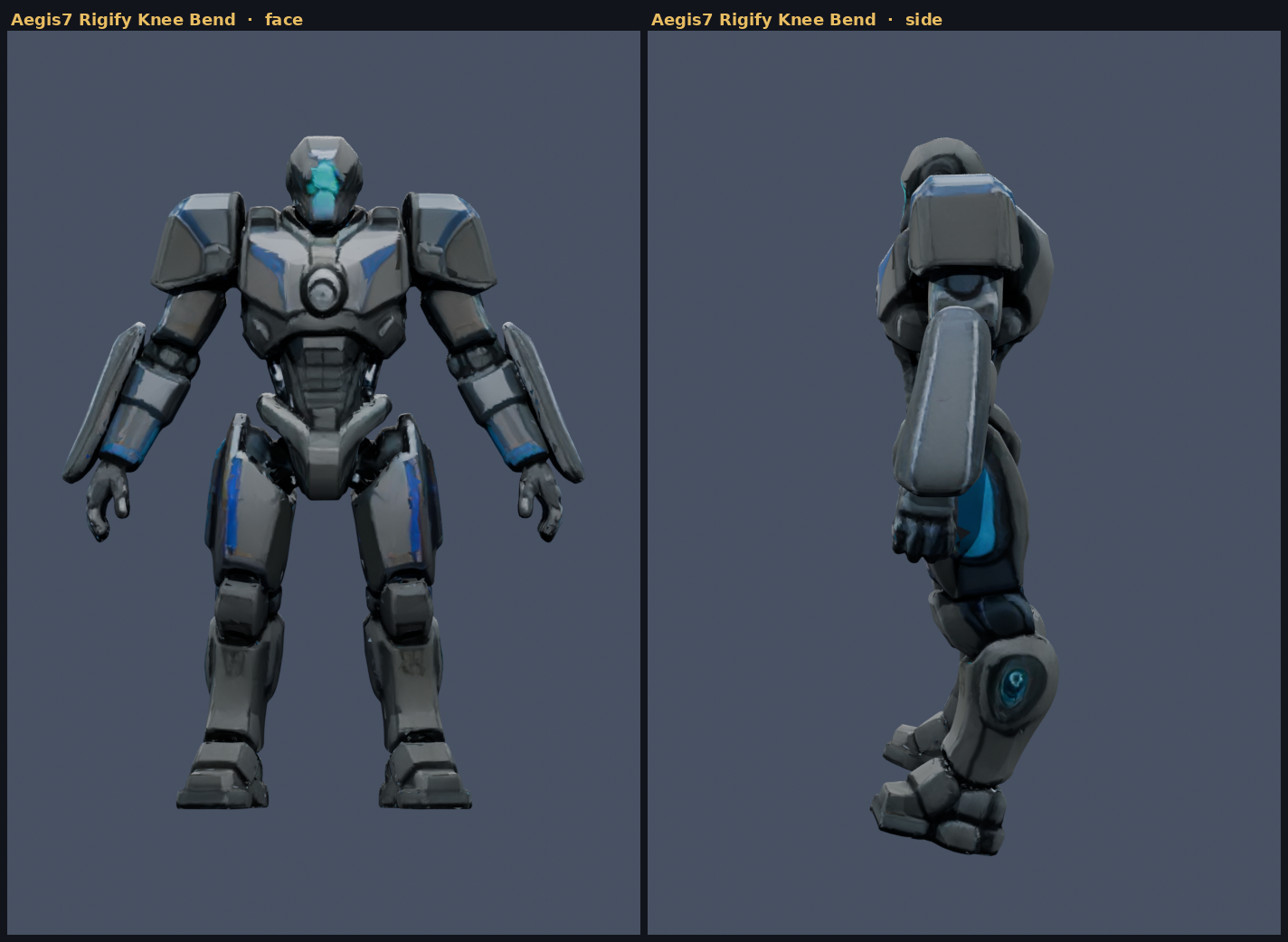
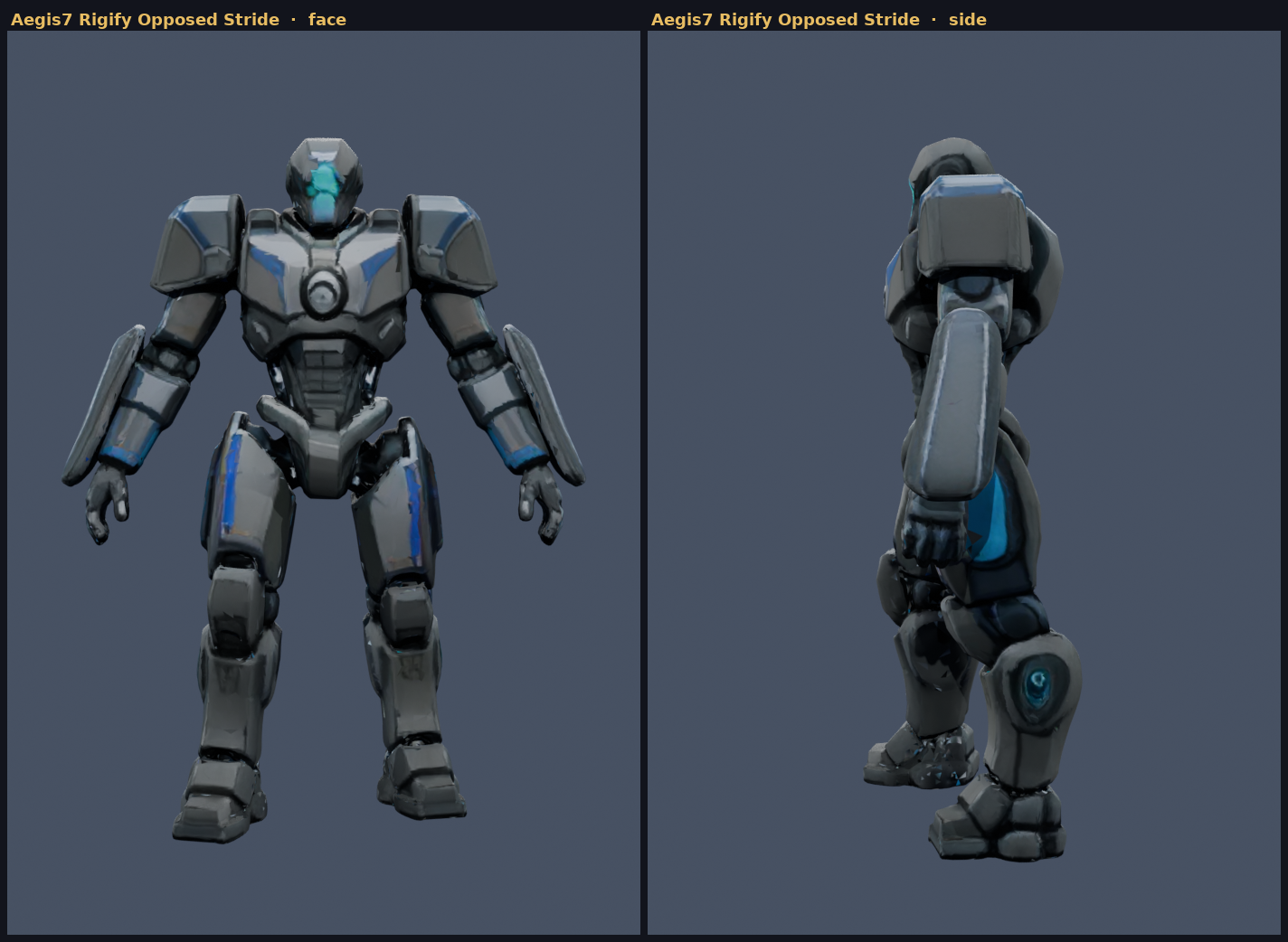
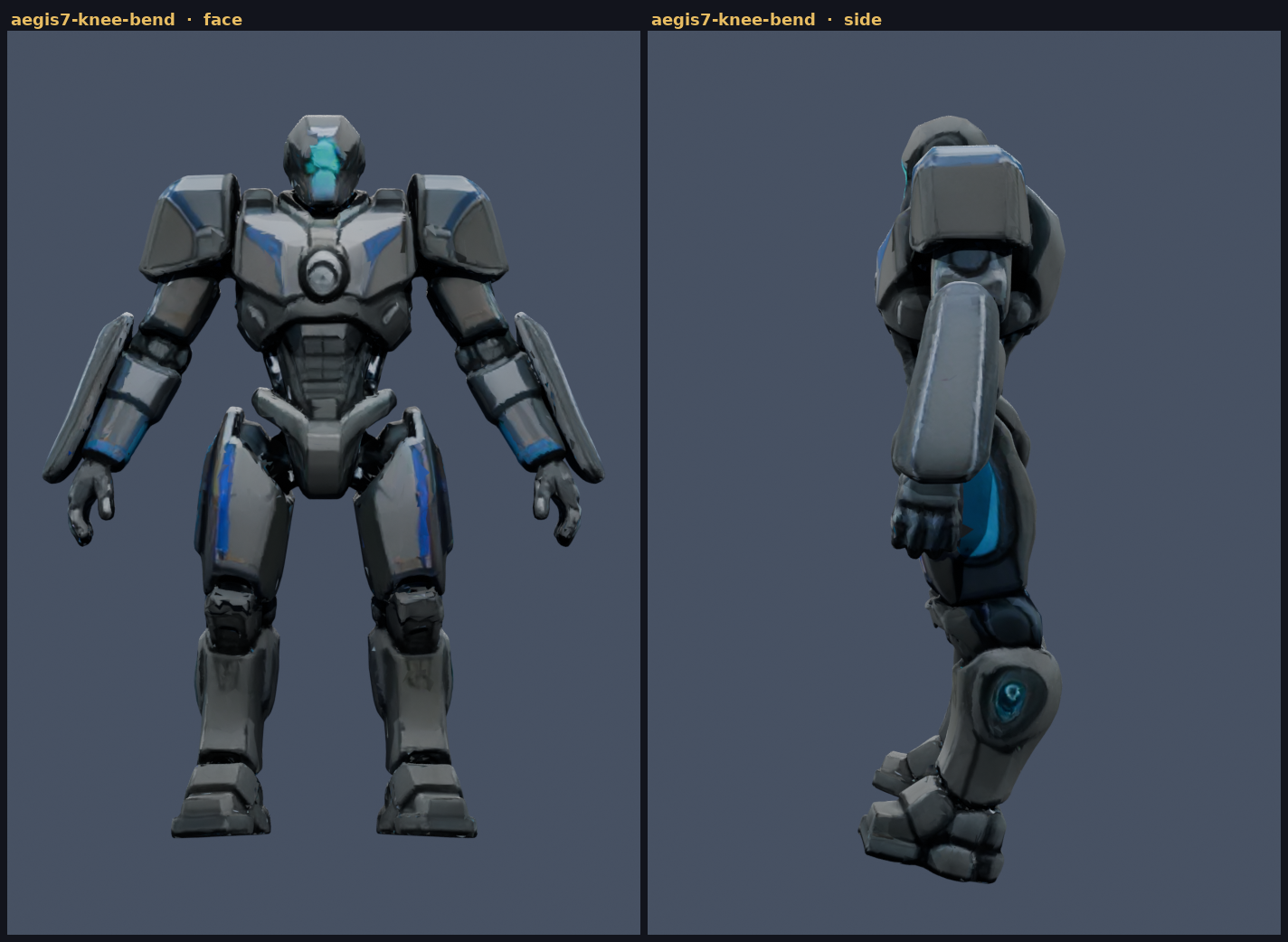
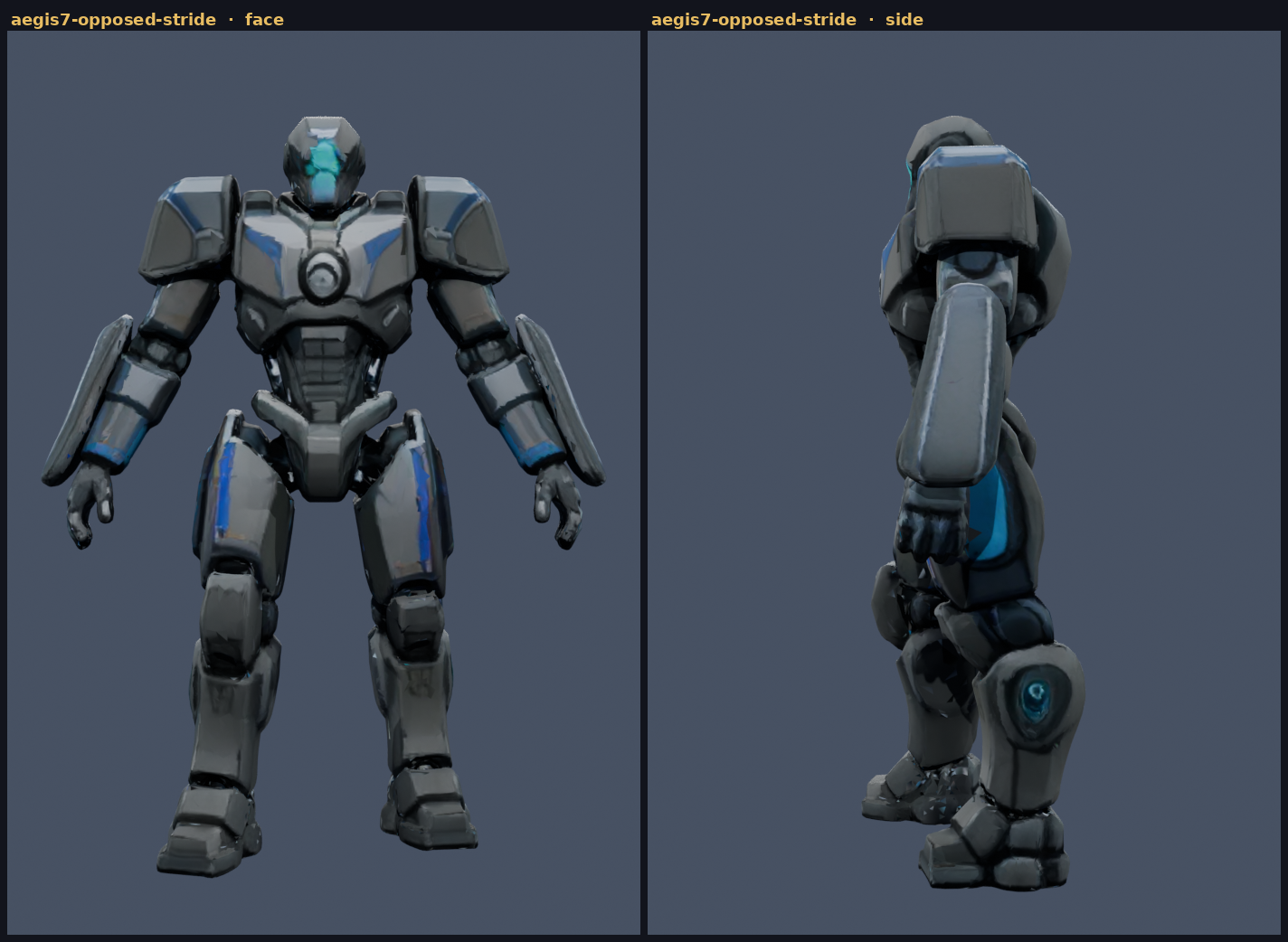
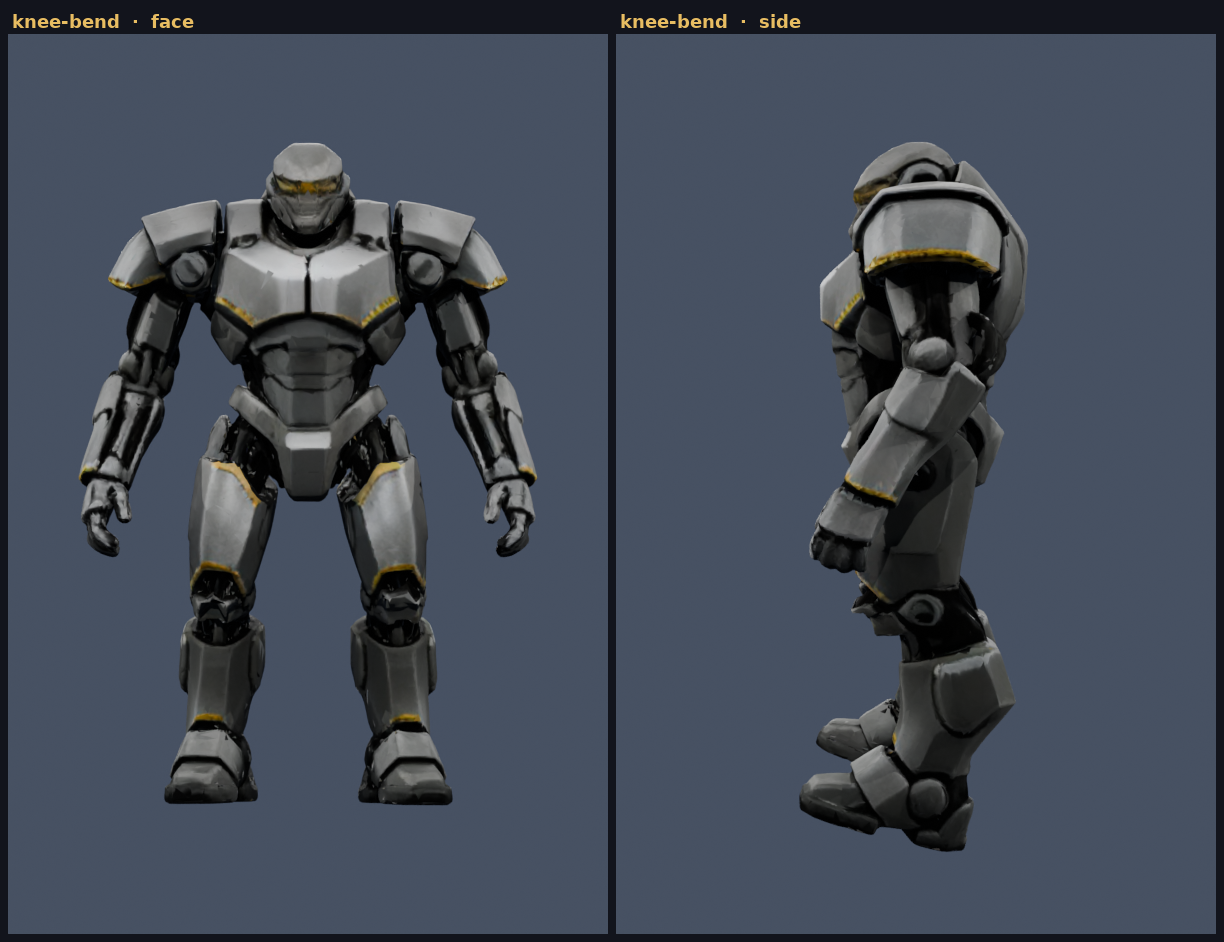
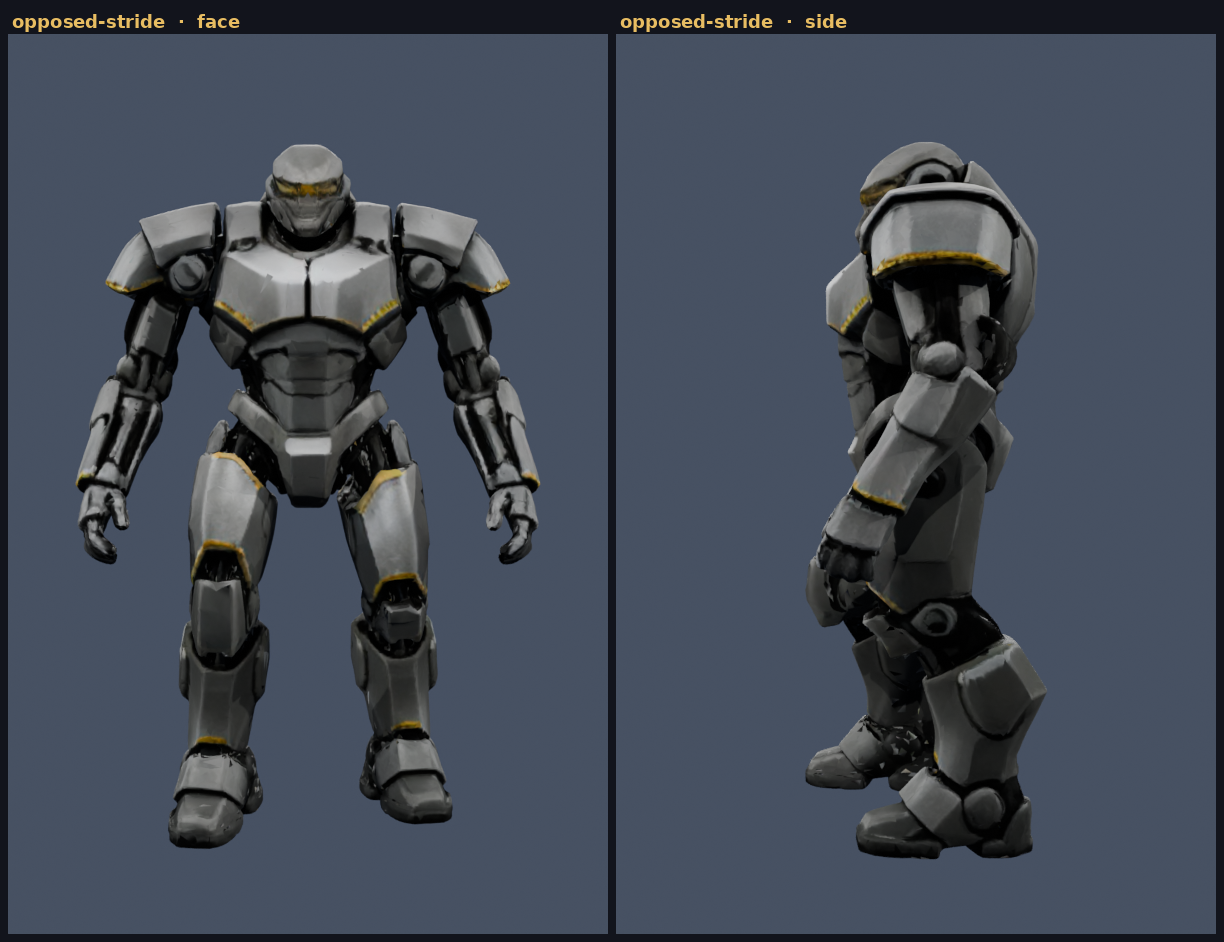
Aegis7 · Rigify diagnostic poses existing skin · new motion
Rigify control bake · 31 samples per clip · 59,998 triangles · 29 reachable joints · Knee Bend / Opposed Stride.
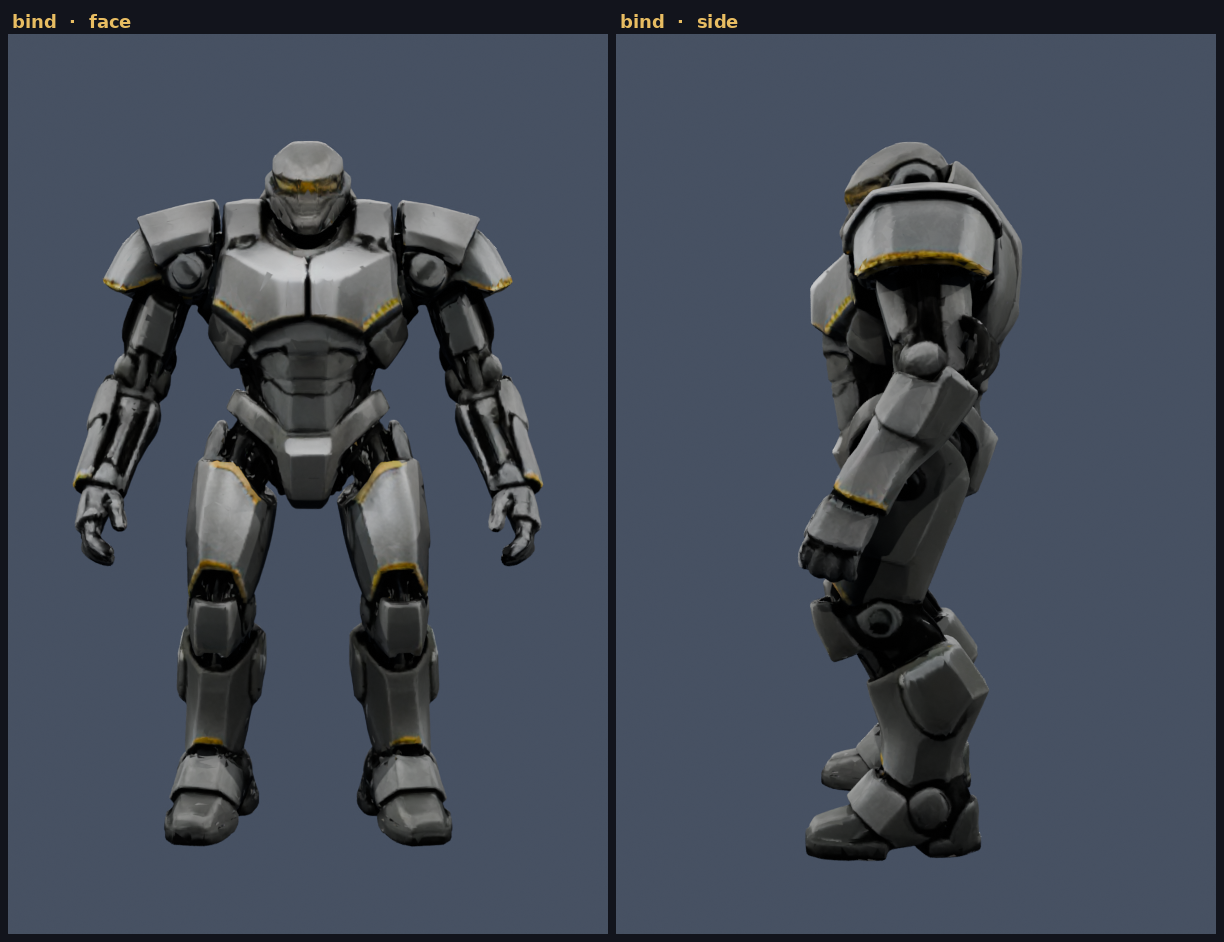
Original mesh, materials and skin preserved; bind → target → bind in one second, not gait or new weights.
Open diagnostic Aegis7 Rigify GLB ·
Open original Aegis7 Rigify GLB (Walk / Run)
Matched projected targets: hip / knee +12° / −28° in Knee Bend;
left +14° / −16° and right −14° / +16° in Opposed Stride. Joint-target error is below 0.00001°;
segment-length drift is below 0.0002 mm and measured lateral joint movement is below 0.00001 mm.
The UniRig comparison uses different joints and weights; these targets do not establish identical motion or planted feet.
Measured surface deformation: maximum vertex movement 105.1 / 123.2 mm (Knee / Stride).
Of 144,456 blended-incident edges, 4,341 / 2,497 stretch over 5%; 99th-percentile length ratios are 1.1083 / 1.0669.
These are local surface-edge measurements, not whole-plate strain or a like-for-like ranking against the different UniRig edge population.
Visible limitations: inner-thigh/pelvis openings, knee and ankle compression, and triangular tearing around the rear foot in Opposed Stride remain.
The original 1.23% dominant-weight rigidity result is unchanged; these clips do not establish rigid armor or planted soles.
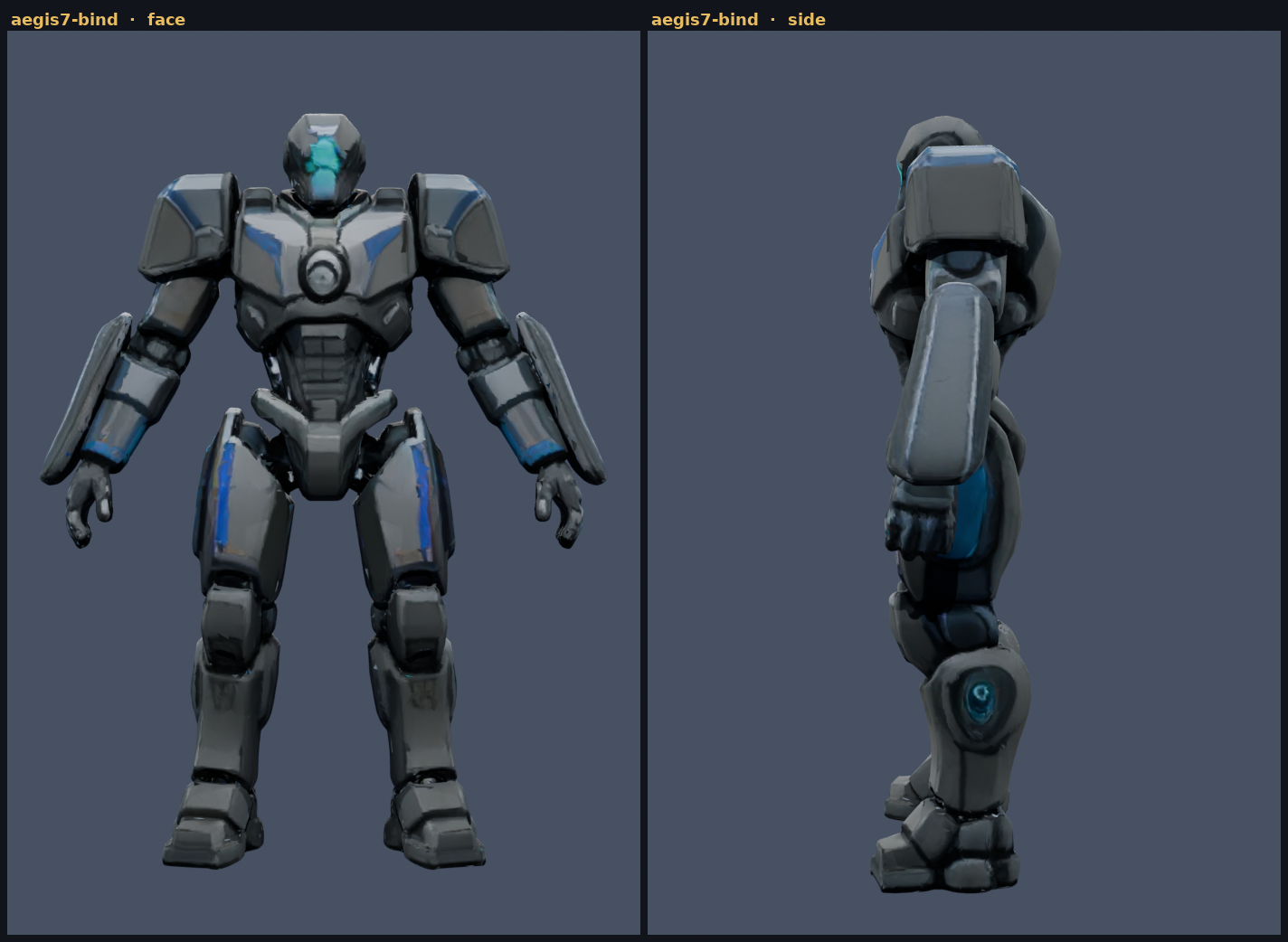
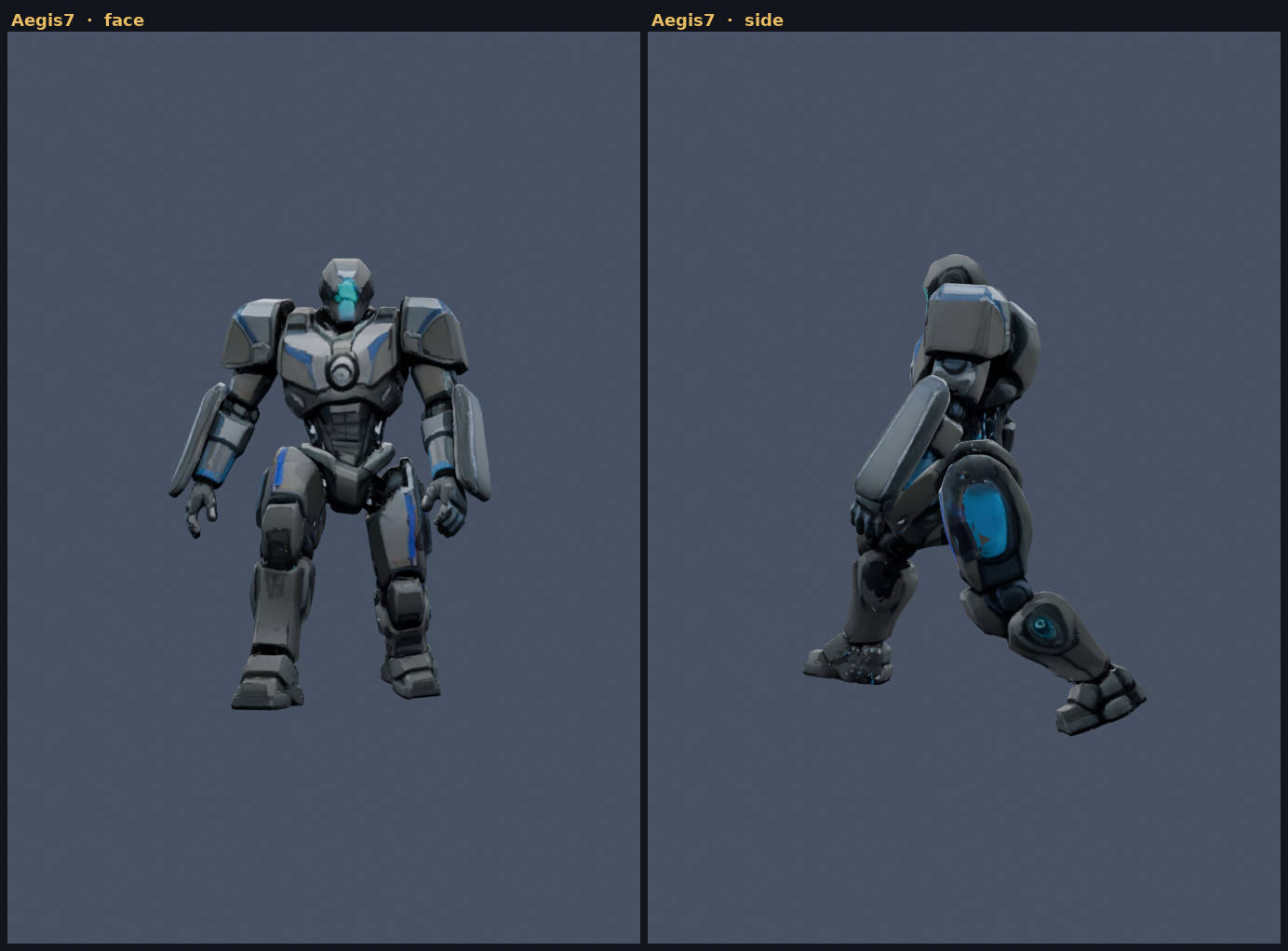
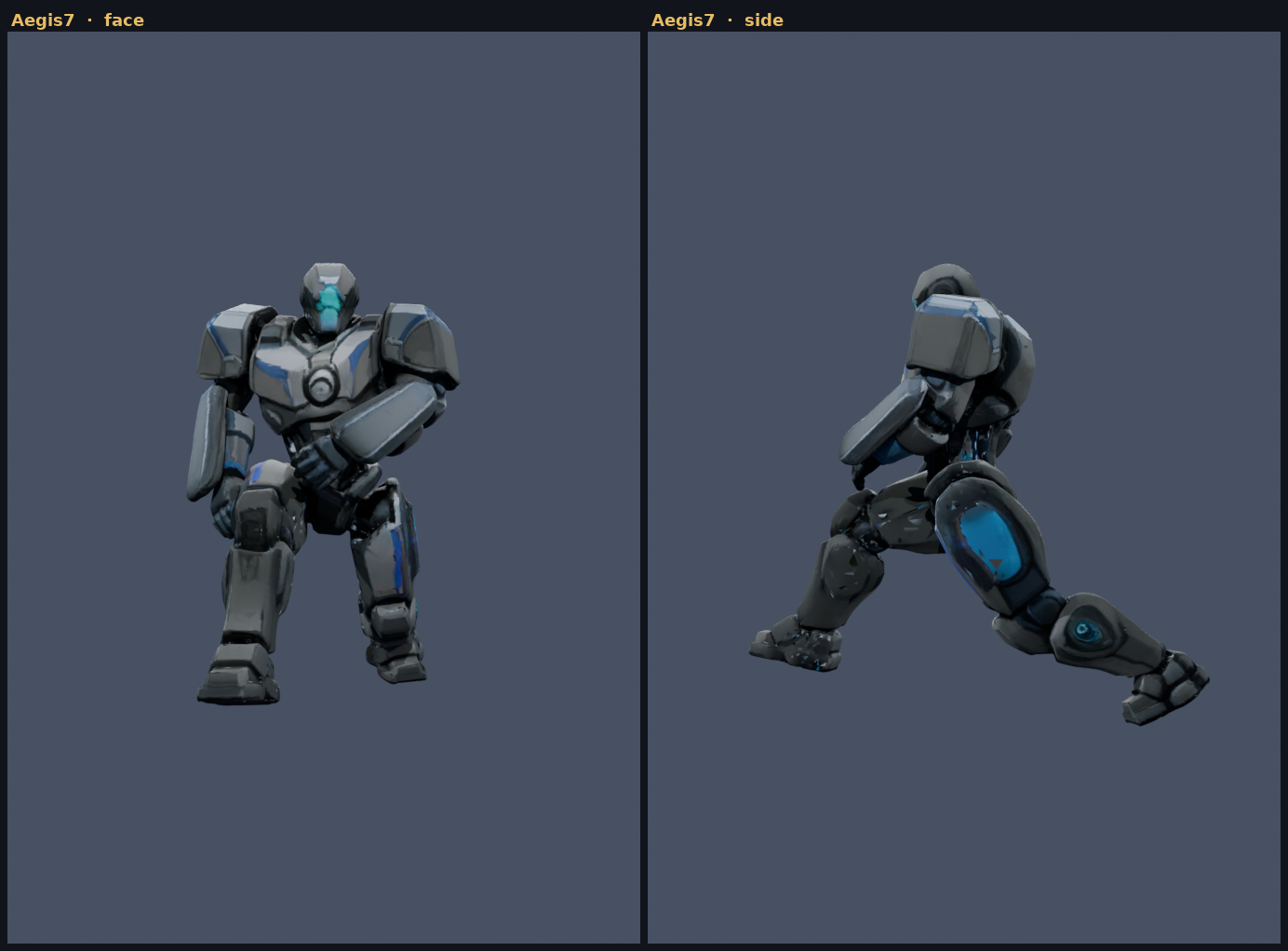
Learned skeleton + neural skin · new diagnostic motion · 59,998 triangles · 28 reachable joints · Knee Bend / Opposed Stride.
Original mesh, materials and weights preserved; bind → target → bind in one second, not gait.
Open diagnostic Aegis7 GLB ·
Open learned Aegis7 GLB (original bind)
Measured limitation: 29.68% single-bone vertices (one influence above 0.000001, maximum weight above 0.999), below the 98% mechanical gate.
This differs from the dominant-weight metric on the Rigify card. Knee buckling and rear ankle/foot tearing remain visible; foot contact is unconstrained.
Measured target poses: maximum vertex movement 107.8 / 104.7 mm (Knee / Stride).
Of 105,069 blended-incident edges, 3,915 / 3,605 stretch over 5%; 99th-percentile length ratios are 1.2273 / 1.1894.
These are local surface-edge measurements, not whole-plate strain. Projected joint angles match targets within 0.10°;
lateral joint movement reaches 22.2 / 5.9 mm, so motion is not purely sagittal.
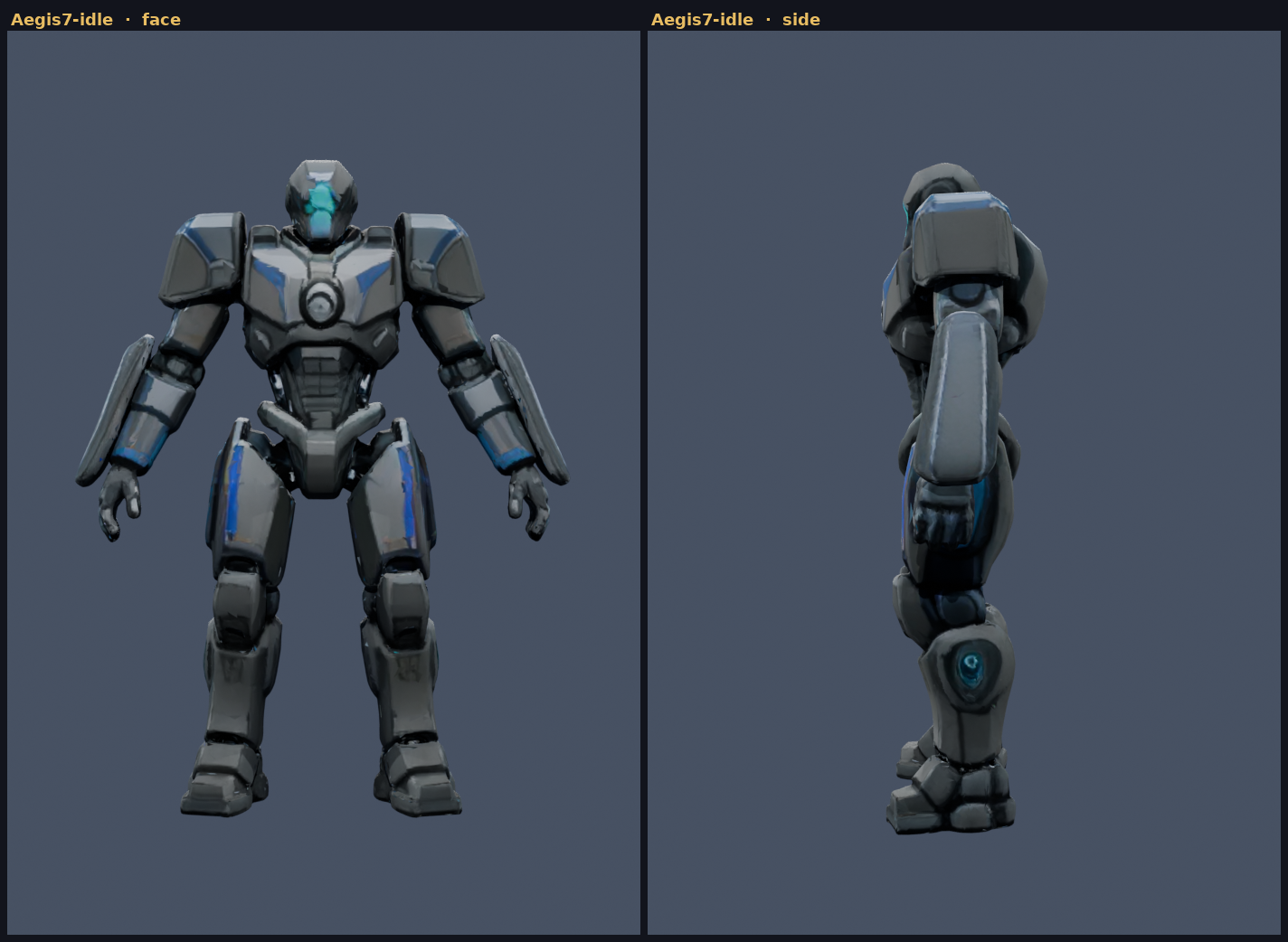
Improved arm motion + retained automatic weights · repaired Aegis7 source · 59,998 triangles · 29 reachable deform joints · Walk / Run / idle / dodge / slide.
Open latest Aegis7 GLB
Runtime roster verification: this exact export now loads for Aegis7 and all five native actions select and advance. Full combat-input and deformation acceptance remain pending.
Corrected bilateral elbow flexion: Walk 20–45°, Run 50–90°. Wrist fit and forearm/torso overlap remain unfinished. Current evidence: Walk · Run.
Measured limitations: only 1.23% of exported vertices have a dominant weight ≥0.98.
Hip, knee and shoulder compression, plus triangular artifacts around the pelvis, inner thighs and ankle, remain visible.
Both clips fail the control-velocity loop-seam check. Exported transforms match the authoring rig; this does not establish rigid plates or planted mesh soles.
01 · Rigify sole-contact variation new experiment · defects
Corrected elbow motion · Walk/Run · both elbows flex 20–45° in Walk and 50–90° in Run; non-arm curves and sole-contact weights preserved. Foot and armor deformation remain.
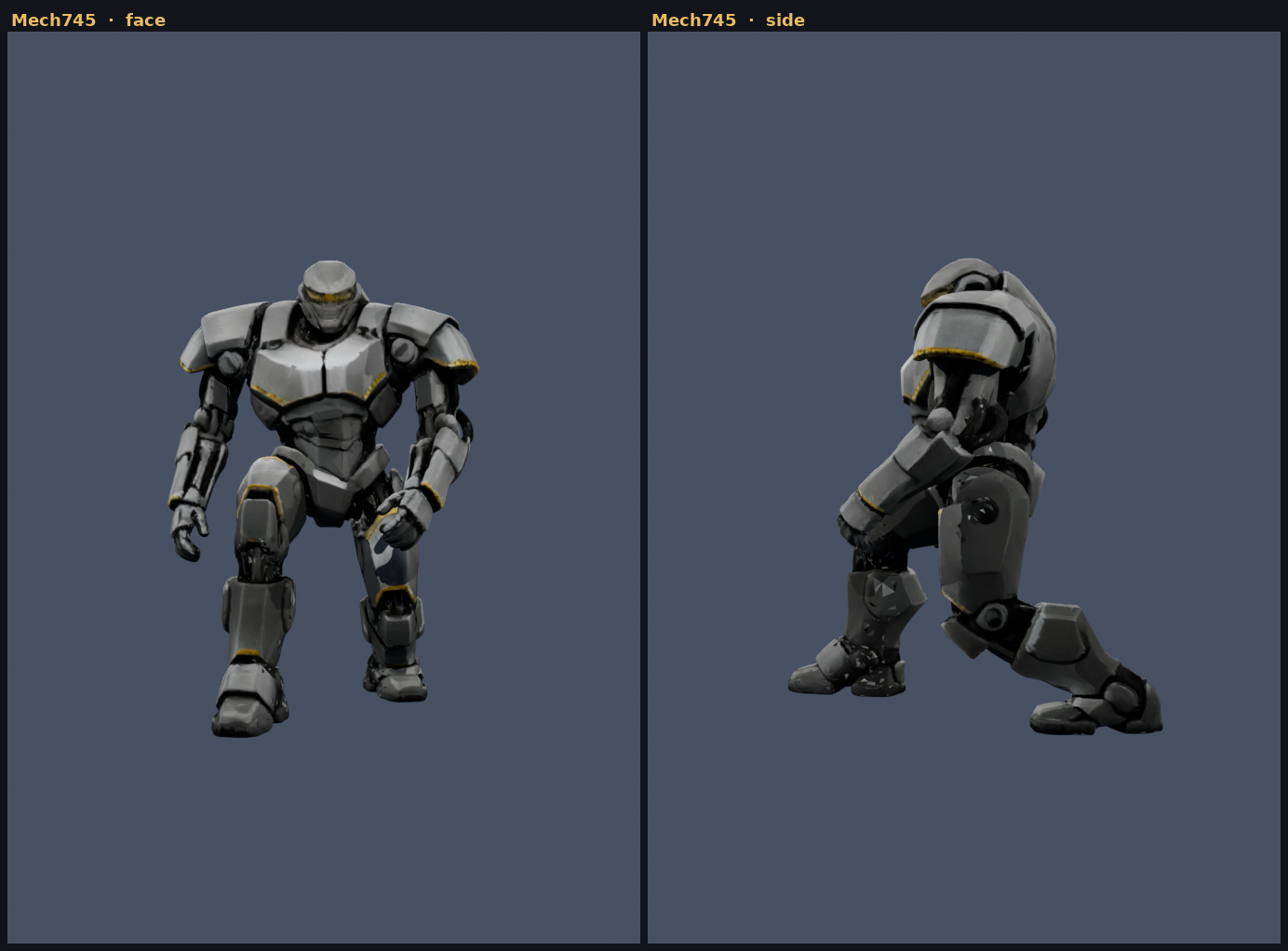
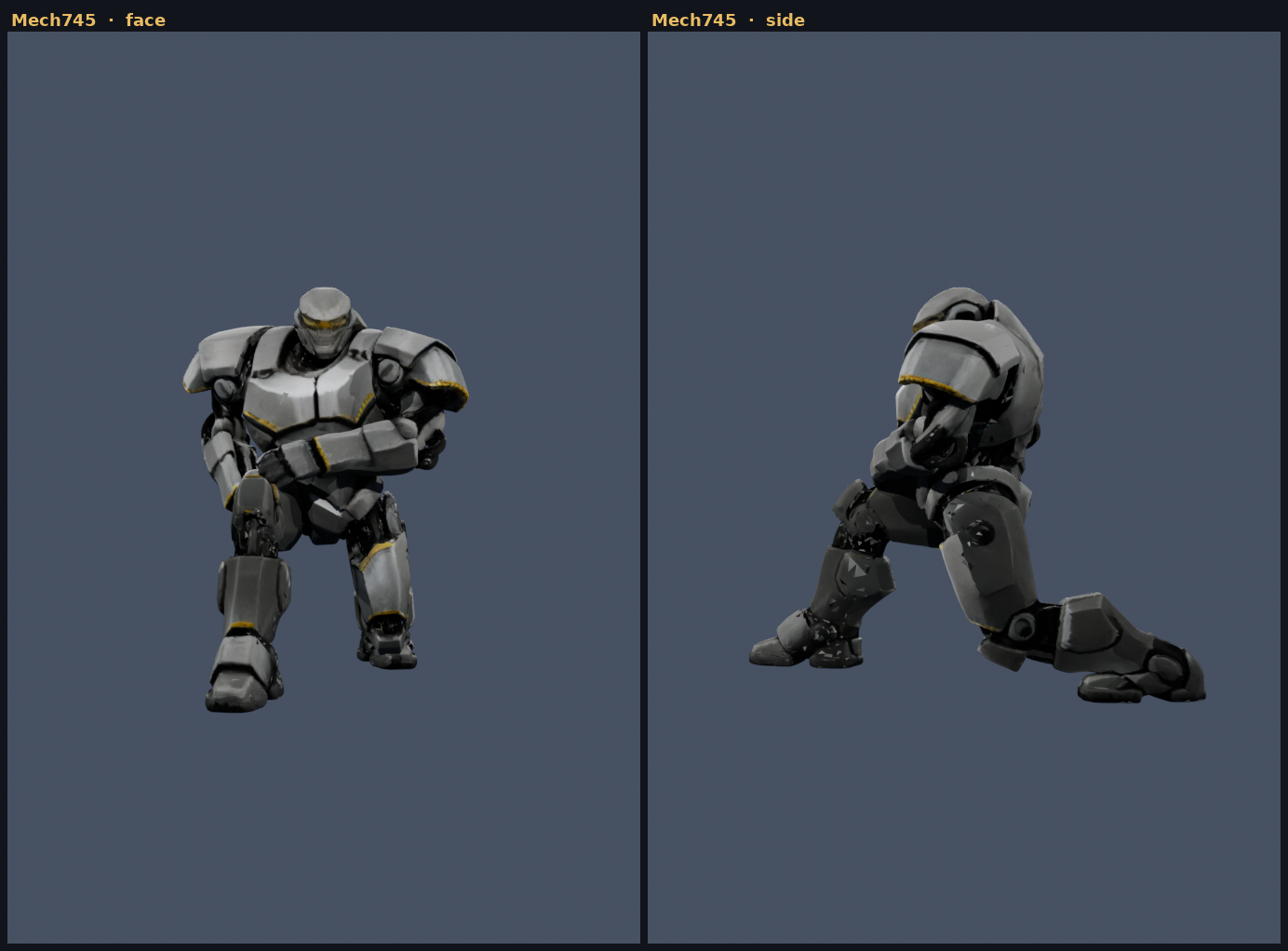
03 · Rigify diagnostic poses existing skin · new motion
Rigify control bake · 31 samples per clip · Knee Bend / Opposed Stride · original mesh, materials and skin preserved; new diagnostic motion, not new weights or gait.
Open diagnostic GLB
Measured target angles: Knee Bend hips +12° / knees −28°; Opposed Stride hips ±14° / knees ∓16°.
Blended-edge p99 stretch: 1.096× / 1.084×; 4,226 / 3,915 of 145,100 edges stretch over 5%. Different blended-edge populations prevent a direct count ranking against UniRig.
Ankle compression and uneven feet remain; contact is unconstrained. Maximum vertex motion: 110 / 130 mm. No overall visual improvement is established.
Technique: UniRig predicts the skeleton and skin weights; its existing transfer tool maps learned
weights onto the repaired source mesh and materials. Blender automatic weights are not used for this candidate.
Verified inference: pinned skin checkpoint SHA-256 checked before loading; inference peak
6.75 GB, zero swap. FlashAttention executes on the GPU; the GPL runtime remains internal.
Controlled motion: each one-second clip moves from bind to a bounded leg pose and back.
The original mesh, materials and learned weights are preserved. These are diagnostic poses, not an authored gait.
Visible defects: knee armor changes shape and the trailing ankle crumples. Foot contact is not constrained.
Measured pose response: maximum vertex movement is 122 mm for Knee Bend and 108 mm for Opposed Stride.
Triangles whose three vertices share a ≥98% bone influence retain edge lengths within 0.002%;
this restricted check does not clear the visibly distorted blended armor.
Blended-surface strain: of 106,883 unique edges touching blended vertices, 4,762 stretch by more than 5%
in Knee Bend and 4,733 in Opposed Stride. The 99th-percentile length ratios are 1.253× / 1.227×.
Extreme ratios reach 6.46× / 4.99× on an 8.12 mm rest edge; these are local mesh-edge measurements, not whole-plate stretch.
Still unfinished: authored locomotion, rigid armor behavior and actual gameplay integration.
Technique: genuine Blender Rigify human metarig → generated control rig → Bone Heat weights →
sole-contact weight correction → gameplay-profile control animation → arm-only elbow/wrist refresh → baked GLB. Retained repaired source and skin;
the automatic-weight baseline remains above for comparison. The correction transfers low sole shin weights to foot/toe bones,
tapering to the original weights at 0.16 m. It does not establish planted-foot stability or fix the armor blending.
Technical load: independent mesh, skin, and Walk/Run checks pass; CPU Cycles renders load the exported GLB.
Playback: the new elbow export loads automatically and both Walk/Run controls advance in both gallery locations, verified with the published model in a browser.
Corrected transform check — Sep 8: matching the source and exported clip origins passes the unchanged
strict thresholds. Across 25 sampled phases, maximum translation error is below 0.001 mm for Walk and Run.
The previous 69.25 mm and 22.81° report compared different poses on the earlier export, not a measured defect fixed by this arm change.
The new arm-only export preserves every non-arm locomotion curve and source skin assignment.
Failed rigidity check: only 1.62% of vertices have one bone influence versus the 98% target.
The renders show bent abdominal armor and angular knee/ankle deformation.
Measured elbow change: both sides now flex 20–45° in Walk and 50–90° in Run, previously about 12–30° in both clips.
Neutral wrist keys follow the forearms, but the Run forearm sweeps across the belly and needs plane alignment. This does not repair compressed feet or ankle armor.
Unverified: ground contact, transitions, mounts, and actual on-foot controller integration.