Model Fidelity — Full Pipeline
The pipeline, stage by stage
Source — a known-excellent base stable
A MakeHuman CC0 body (14,738 verts, uniform UV) plus a commercially-usable mo-cap library. The base is anatomically clean and rigs/retargets reliably — the properties the raw forge mesh lacks.
Decompose & map parts stable
The reference is split into parts (body, head, hands). Our forged geometry supplies identity (silhouette + texture); the CC0 golden mesh supplies the deforming body + skeleton. Parts are scaled to align the forged proportions onto the golden topology — identity is carried entirely by the texture, so one clean mesh deforms for everyone.
Golden body + bulk/size stable
One shared golden mesh, morphed per character for stature and build (small/medium/large × lean→heavy) as a fast macro-morph — no re-forge, no GPU.
art-gen/golden_rig.py --bulk · bulk & height tuner →Transplant the forged texture stable
The forged per-character skin is baked onto the golden body's UV atlas, so the proven mesh wears the character's identity.
art-gen/apply_texture.py · golden bake + verifyBetter-resolution face — head-map verified · face
The hi-res forged head is cloned into the body atlas with a Poisson seamless-clone: boundary
tone matches by construction, so the face-to-scalp seam disappears — and, decisively, the real
eyes, brows, nose and lips are restored instead of the old moment-match's featureless pale mask
with empty black eye-holes. Measured on ariel_sorin: seam tone-step ΔE 5.0 → 2.5
(halved), facial-feature pixels up 4.3×. (The pale-face and hair-through-scalp code paths
didn't trigger on this character — no blowout existed to pull down — so those are situational, not the
headline win.)
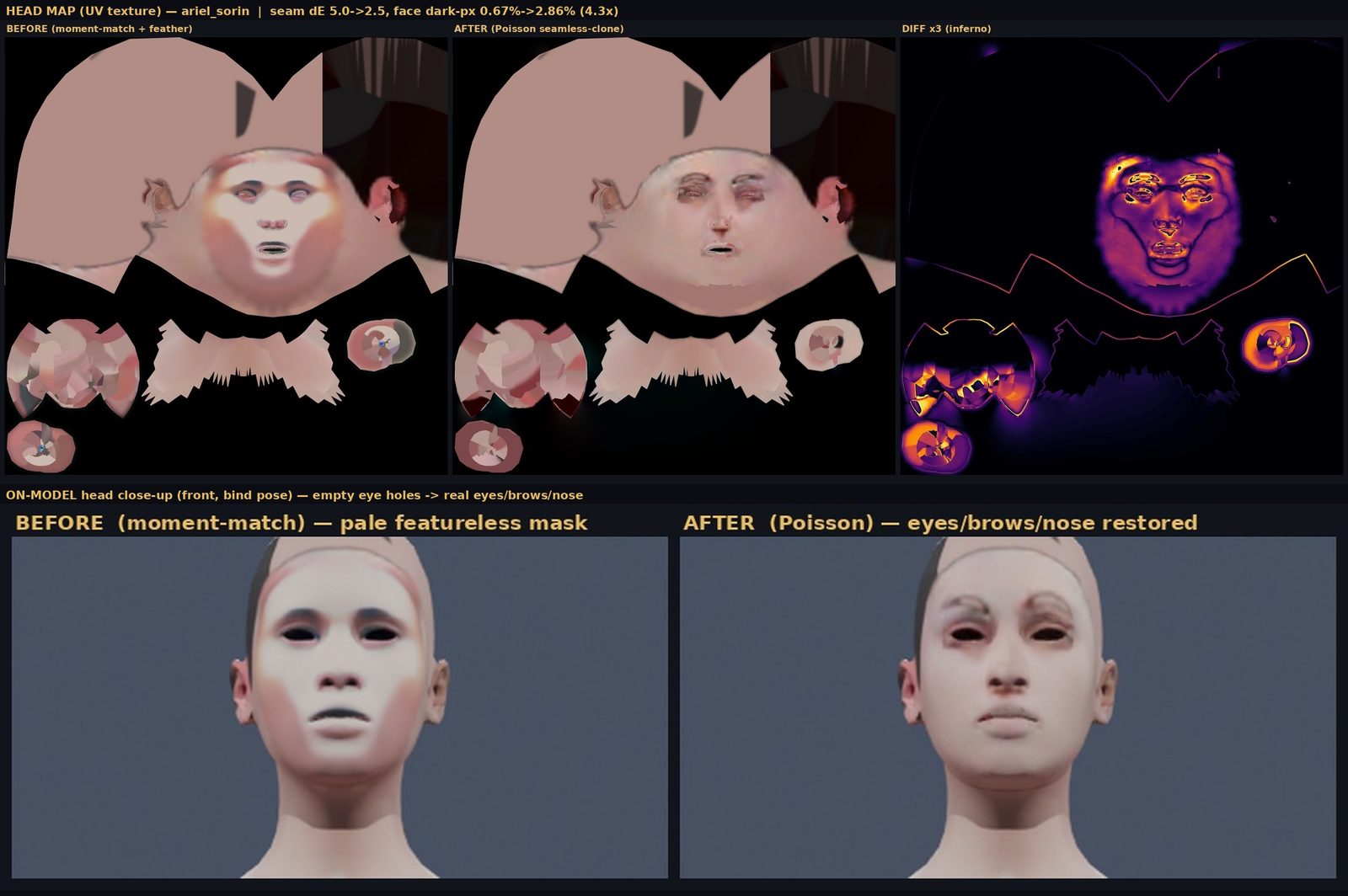
art-gen/uv_headmap.py (cv2 seamless-clone) — committed & verified (face-fidelity)Eyes shipped cast-wide
Four measured bugs fixed — ball-center, oversized eyeballs, bug-eyed flat faces (per-character eyelid-surface recession), and cache staleness — plus per-character/species iris colors.
art-gen/eye_refine.py · eye refinement study →Rig + mo-cap retarget ⚠ skin weights failing gate
The golden skeleton drives the mesh; mo-cap clips retarget onto it via per-clip sidecars, producing the required animation set (23 humanoid motions: locomotion, melee, ranged, reactions).
*_mocap.retarget.json · processed cast → · motion lab — 23 required motions live →Measure — the acceptance gate measuring
"Perfected" is not a vibe. Every clip is run through the fixed surface-deformation harness — per-region stretch, shear, inversion, and Green strain, a pass/fail VERDICT gate, and a shred_index. The rest pose self-tests to ~1.0 to prove the harness is calibrated. A model ships only when it clears the gate under animation.
art-gen/surface_metrics.py · deformation measurements →Live measurements — current run
Measured just now with the fixed harness. The rest-pose self-test reads a clean 1.000 (0 strain, 0 flips) — the harness is calibrated, so every number below is real deformation, not an artifact. Result: 0 of 9 clips clear the gate. The eyes and face texture are solved; the skin weights are not — the golden body tears at the shoulder and self-intersects at the pelvis under motion. This is the next fix, and it is measured, not assumed.
| measurement | result |
|---|---|
| Rest-pose self-test (calibration, must ≈ 1.0) | 1.000 — clean (0 strain, 0 flips) |
| Clips passing the deformation gate (p95 strain ≤ 0.50) | 0 / 9 |
| Worst region across all clips | shoulder_L (deltoid) — strain p95 1.914 on dodge, 3.8× gate; + inverted tris & self-int |
| 2nd hot spot | pelvis / inner-thigh — self-intersects on every locomotion clip |
| shred_index range (idle → run) | 2.0% → 16.6% (scales with motion intensity) |
| Head-map seam ΔE — before → after (ariel_sorin) | 5.0 → 2.5 (halved); facial features +4.3× |
Next: reweight / corrective-fix the shoulder
deltoid, then the pelvis/inner-thigh, and re-run this gate until clips pass. Fix path uses
corrective_blendshape.py / blender_corrective_rig.py.
Composition pipeline — data-driven mechs & walkers new · live in gameplay
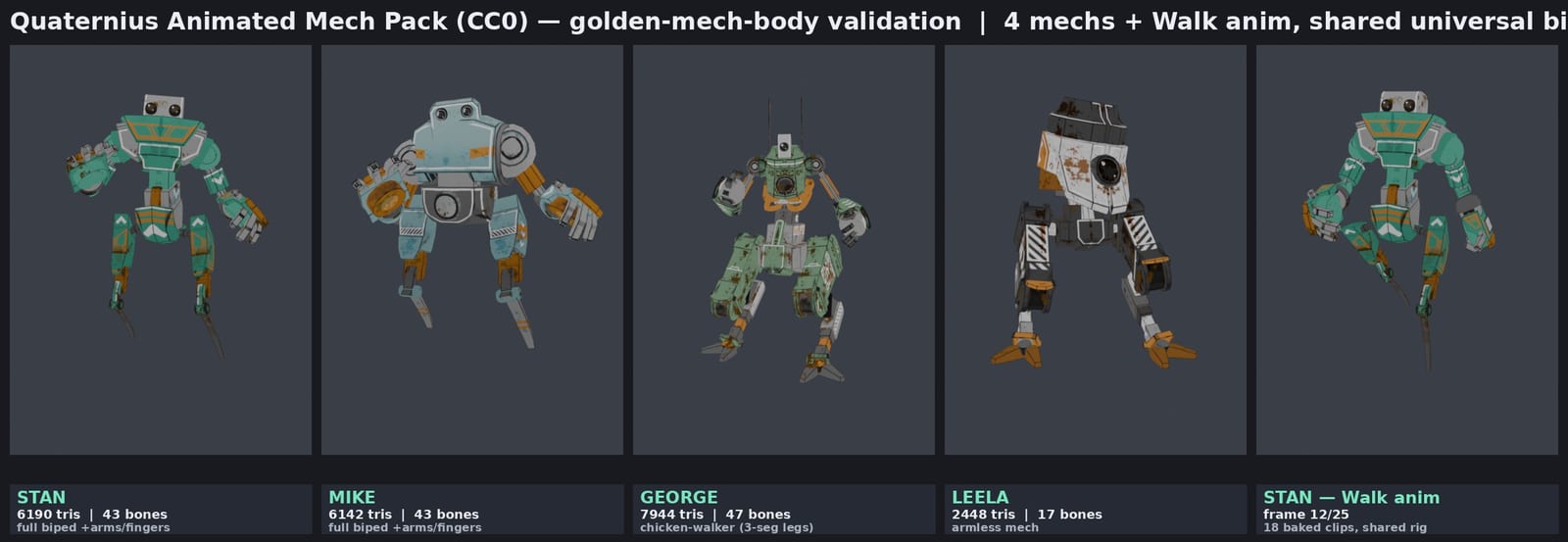
The humanoid pipeline above proved the lesson: don't rig a raw forge — it self-intersects and won't deform. The mech/walker track applies the same lesson a different way. Instead of one baked mesh, a character is a recipe: a known-good CC0 golden body + grafted identity parts + a material preset + equipment slots, which the engine assembles at load time. This is now live in gameplay — the player avatar and the body-picker read the manifest and compose the model, not a pre-baked glb.
The golden-body family
MakeHuman (CC0)
14,738-vert body, uniform UV, 163-bone rig. Skin/graft a forged identity onto it — the stages above.
Quaternius (CC0)
Animated Mech Pack — Stan (biped), Mike (heavy), George (chicken-walker). 43-bone biped rig, 18+ baked clips.
creature-composition
The same recipe for non-humanoid frames — graft signature shells onto a riggable creature base.
Each is a known-good, riggable base we skin identity onto — the opposite of a raw forge that won't rig.
Manifest — the recipe data-driven
Per-character record: base_model + composed_parts (id → bone mount + xform) +
material_preset + equipment_slots. The composition lanes emit this manifest
instead of baking a glb — mount_rigid_auto derives each part's mount & transform.
gear_compose.mount_rigid_autoAssembler — engine builds the node tree runtime
On load the Godot assembler instances the base_model (its Skeleton3D + baked anims),
BoneAttachment3Ds each grafted part at its mount (mirrored for .L/.R), applies the
material preset to semantic slots, and fills equipment slots from the loadout. One assembler drives NPCs, the
player, and the customizer preview — same code, same data.
In-game live: avatar + body picker
The composed mech is assembled at runtime in gameplay — player avatar and the body picker read the recipe. Made editable, the same manifest is the character customizer (mix & match base + parts + colors + equipment on a live render doll).
a01 — mis-forged humanoid → composed mech
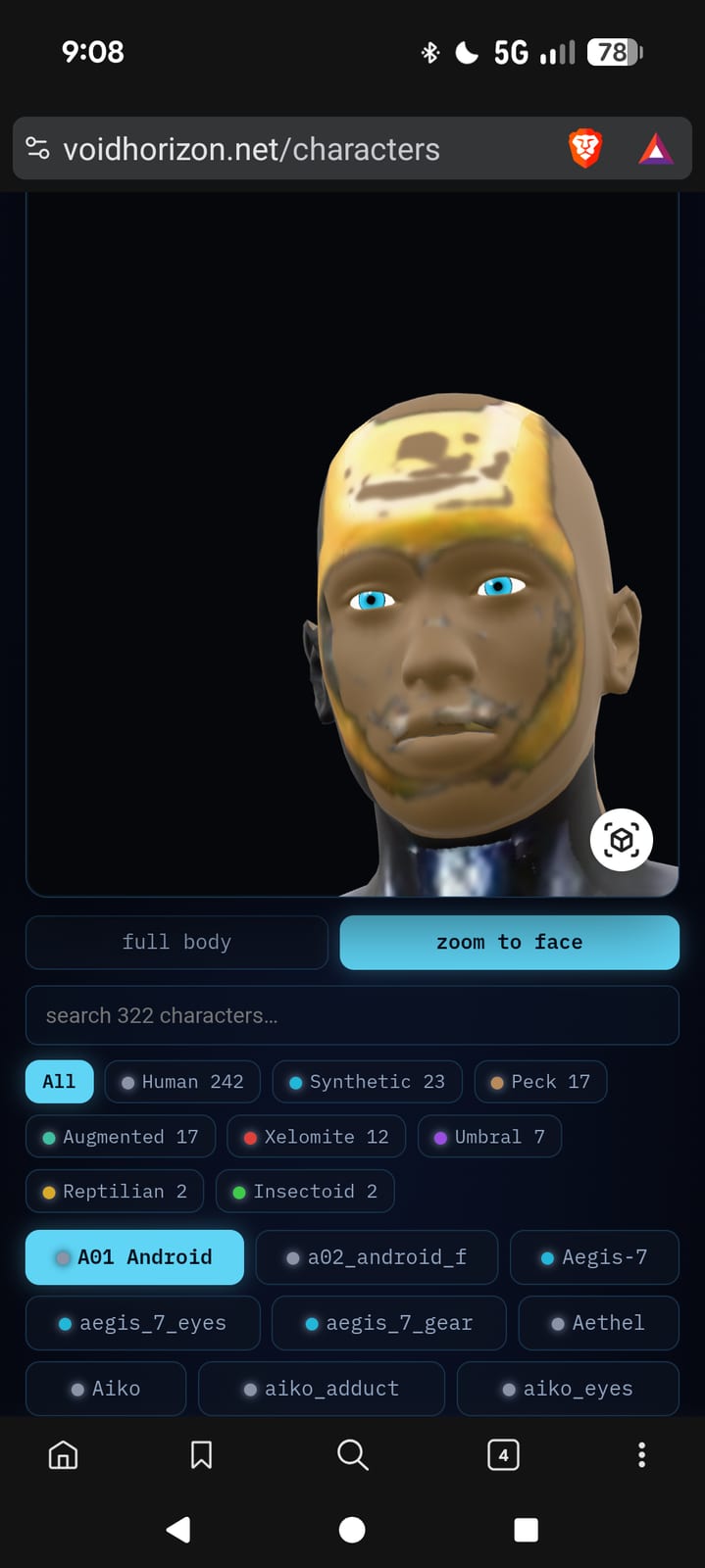
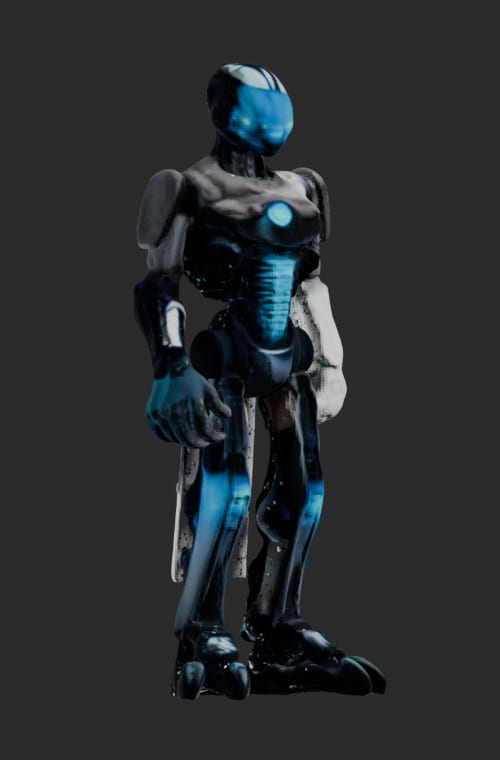
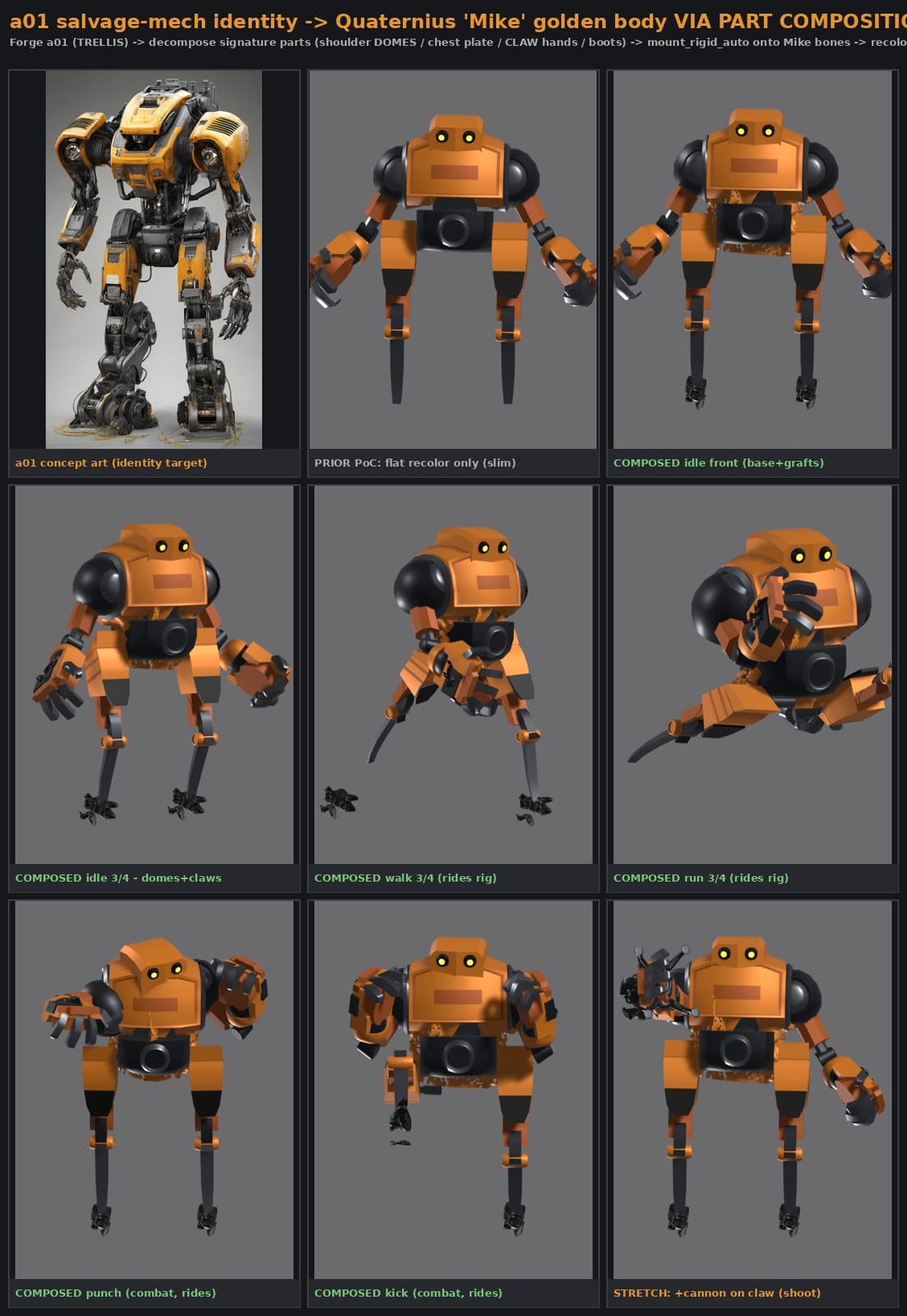
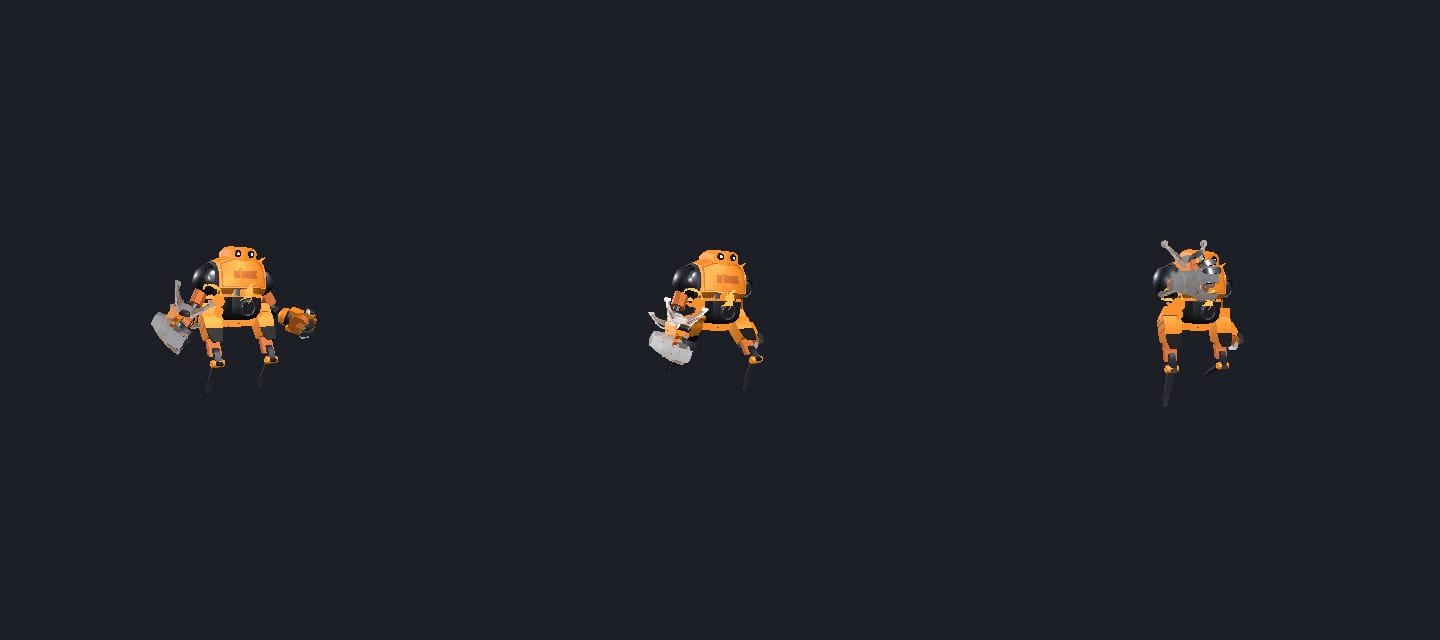
a01 is canonically a salvage-mech, but it had been mis-forged onto the humanoid body — so its forged mech-face smeared across a human head (below left). Redone as a composed mech: Quaternius Mike base + grafted shoulder domes / chest plate / claw hands + a salvage recolor. 🤖 How close can composition alone get to the concept? — the convergence study → (six iterations toward the concept art, with the method's measured limits).
Hard-surface single-mesh forge — the mech-overhaul new · task-748
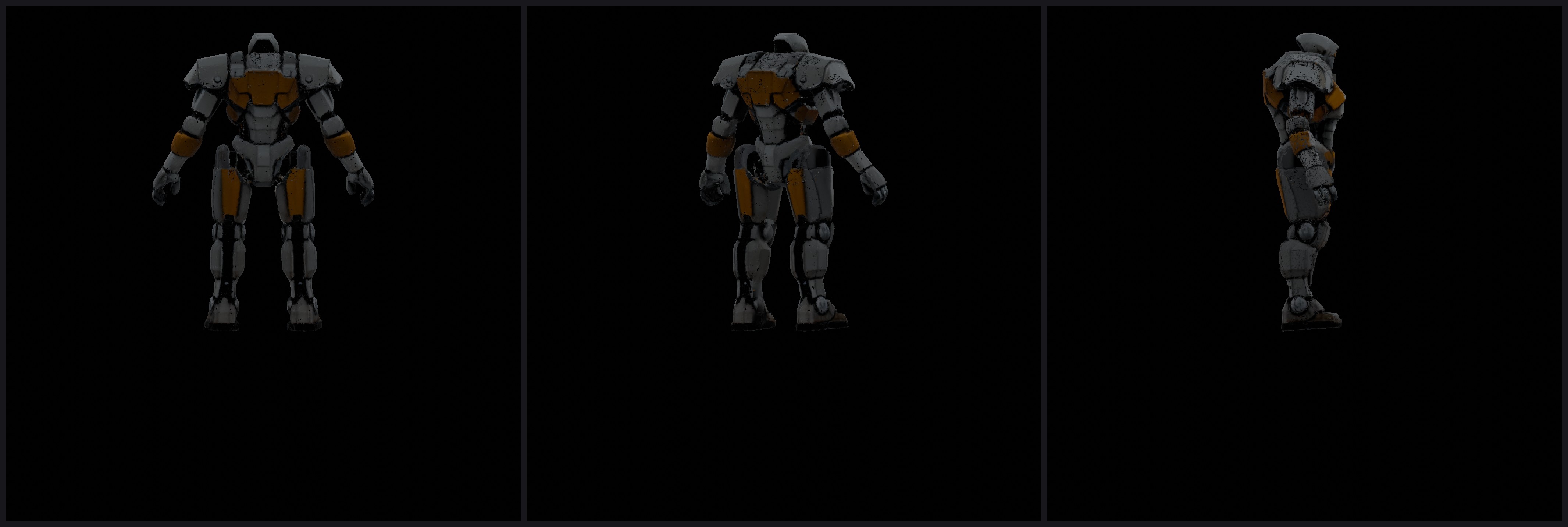
The composition method above still stands for the golden-body humanoid/organic track (skin identity onto a proven deforming body). For rigid hard-surface combat robots it hit a ceiling: bolting forged armor fragments onto a low-poly Quaternius base reads as a fragmented, low-detail bot up close. The fix is the same lesson applied differently — forge the WHOLE robot as one coherent high-poly textured mesh (the welded plates ARE the geometry, not separate grafted parts), then rig it onto a clean biped skeleton with rigid per-plate skinning (no organic deformation needed for rigid armor).
Concept driver (provider-selected) 1-2 candidates, no sweep
A single clean plain-background full-body A-pose concept per character — the armor plating IS baked
into the driver image (the deliberate exception to the base-body rule: a mech's armor is the model).
Codex/GPT agents use the directly exposed OpenAI image-generation tool or gpt-image-2 API;
agy is a secondary remote provider, while FLUX/SD3.5/SDXL remain local fallbacks. Every
cached driver records provider, image model, prompt, input hashes, output hash, and selection.
Image → 3D, image-driven no humanoid rig
Hunyuan3D-2 shape (octree 512) → Hunyuan3D-Paint → normalize (height 1.8, feet at 0) → one coherent textured master mesh, ~1-1.3M source tris.
art-gen/forge_character.sh · HY_OCTREE=512Repair + rig static accepted · motion gated
Before the unchanged decimation collapse, identical exported positions are reconnected. That fixes the export-split/decimation fractures on the verified non-Warhound static candidates without distance welding, smoothing, or deleting geometry. The old custom 17-bone animation still shears at the thighs; the richer Rigify path must clear sole contact, posture, transition, and export-fidelity gates before it replaces any animated model.
exact-position reconnect → COLLAPSE · static surface ≠ accepted animationStore + promote binaries LFS + R2
Forged sources and game-loaded GLBs are versioned through the private R2-backed Git LFS endpoint.
A curated web model is copied to public R2 by scripts/publish-web-models.ts and served
through the same-origin /models proxy. Heavy review media also goes to public R2; only
small thumbnails remain ordinary Pages Git blobs.
a01 — three generations of the same character
a01 shows the whole arc: mis-forged onto the humanoid body (Aug 31, above) → composed onto a Quaternius base (Aug 31, also now superseded) → this coherent forge (Sep 5, current). Clean, no seam between "parts" because there are no parts — one mesh.
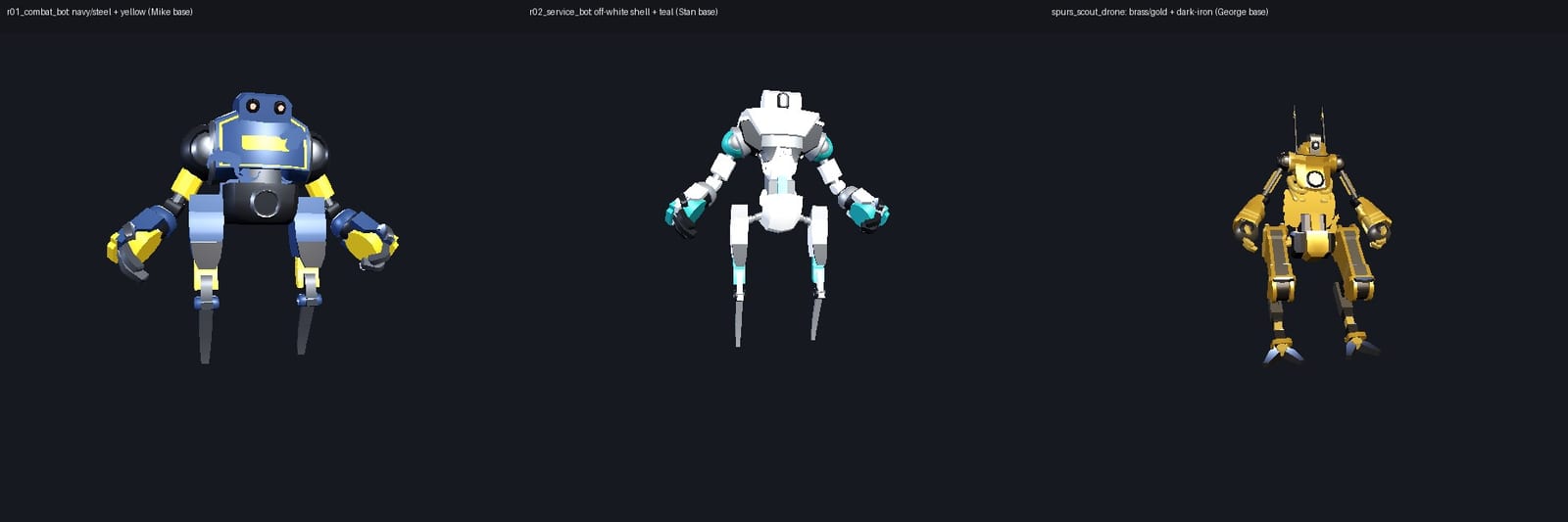
r01 — the walker-lineup character, redone
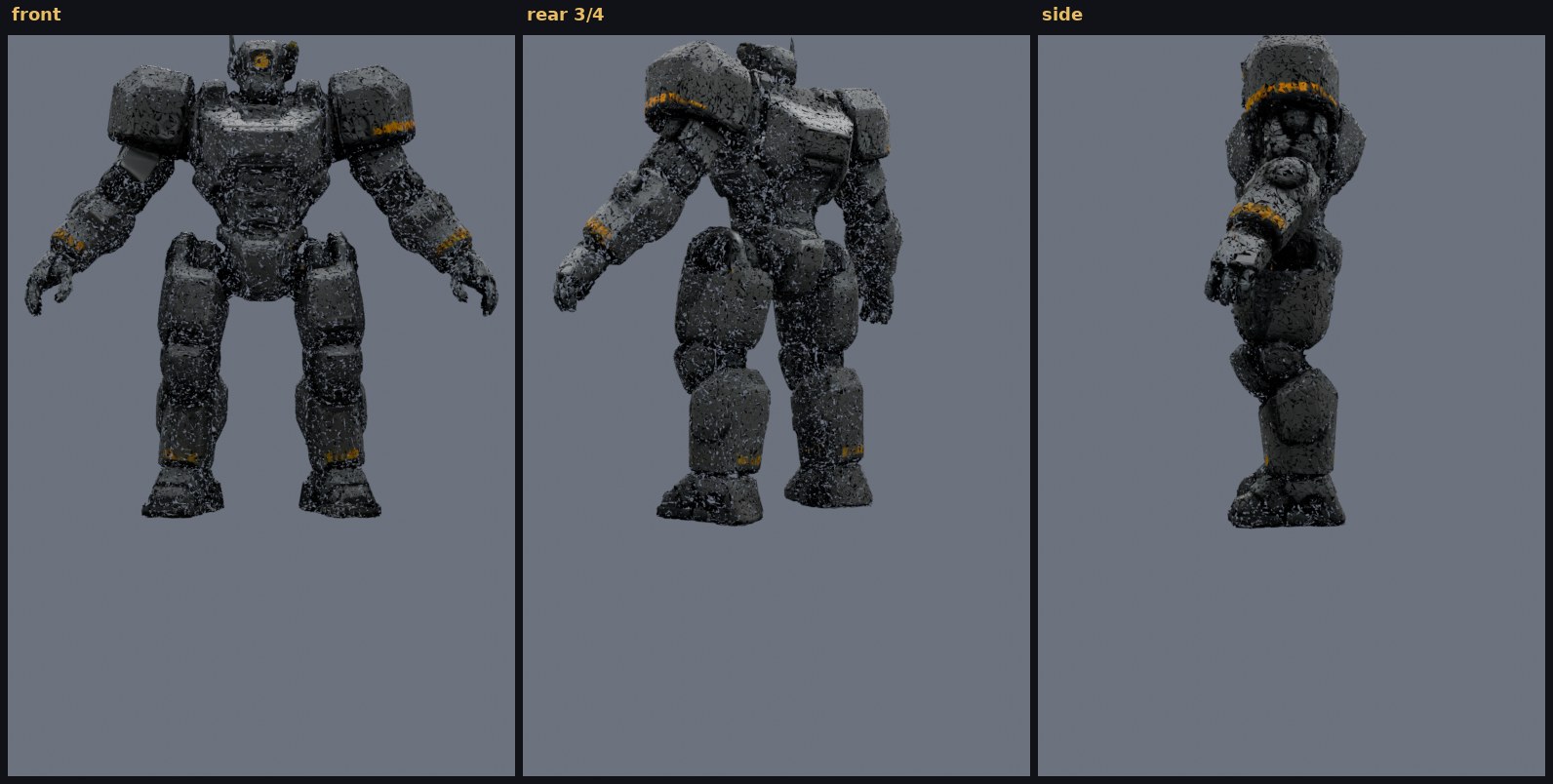
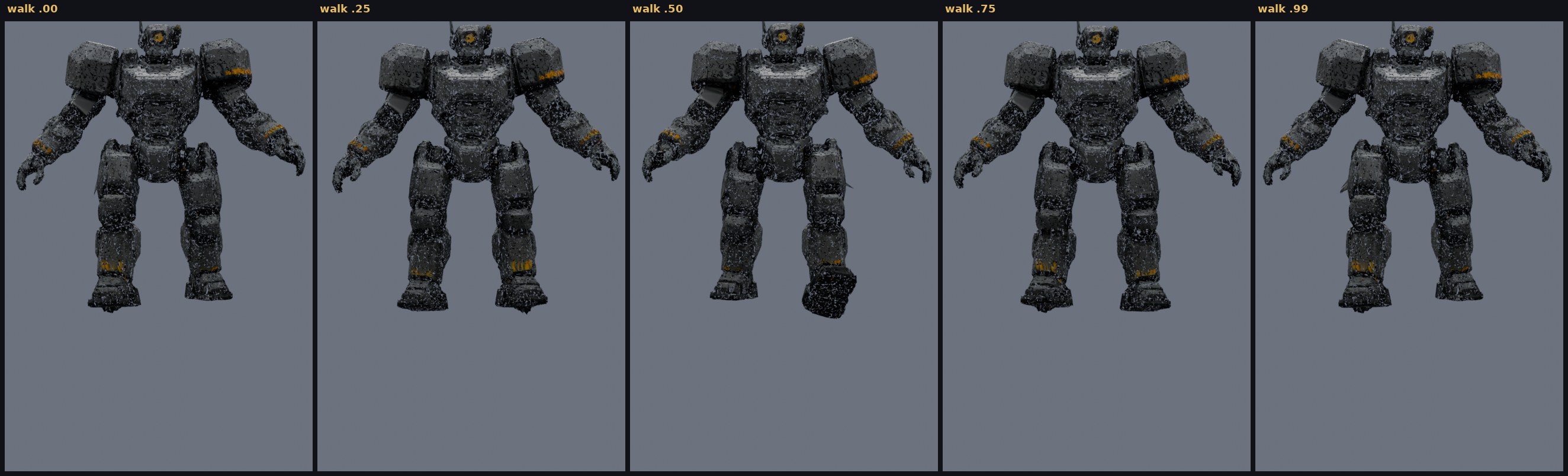
More of the 23-strong coherent cast
23 characters have gone through this forge so far: a01, a02, aegis_7, android_king, aura_net, chronosync, daemon_enforcer, dharma_unit_7, doc_holliday_7, echo_chrome, nexus_prime, null_pointer, r01, r02_service_bot, rev9_preacher, shadow_null_bruiser, shadow_signal_jammer, spurs_scout_drone, synthetix_primus, the_synthetic_analyst, vex_7, vite_01, zig_combat_android.
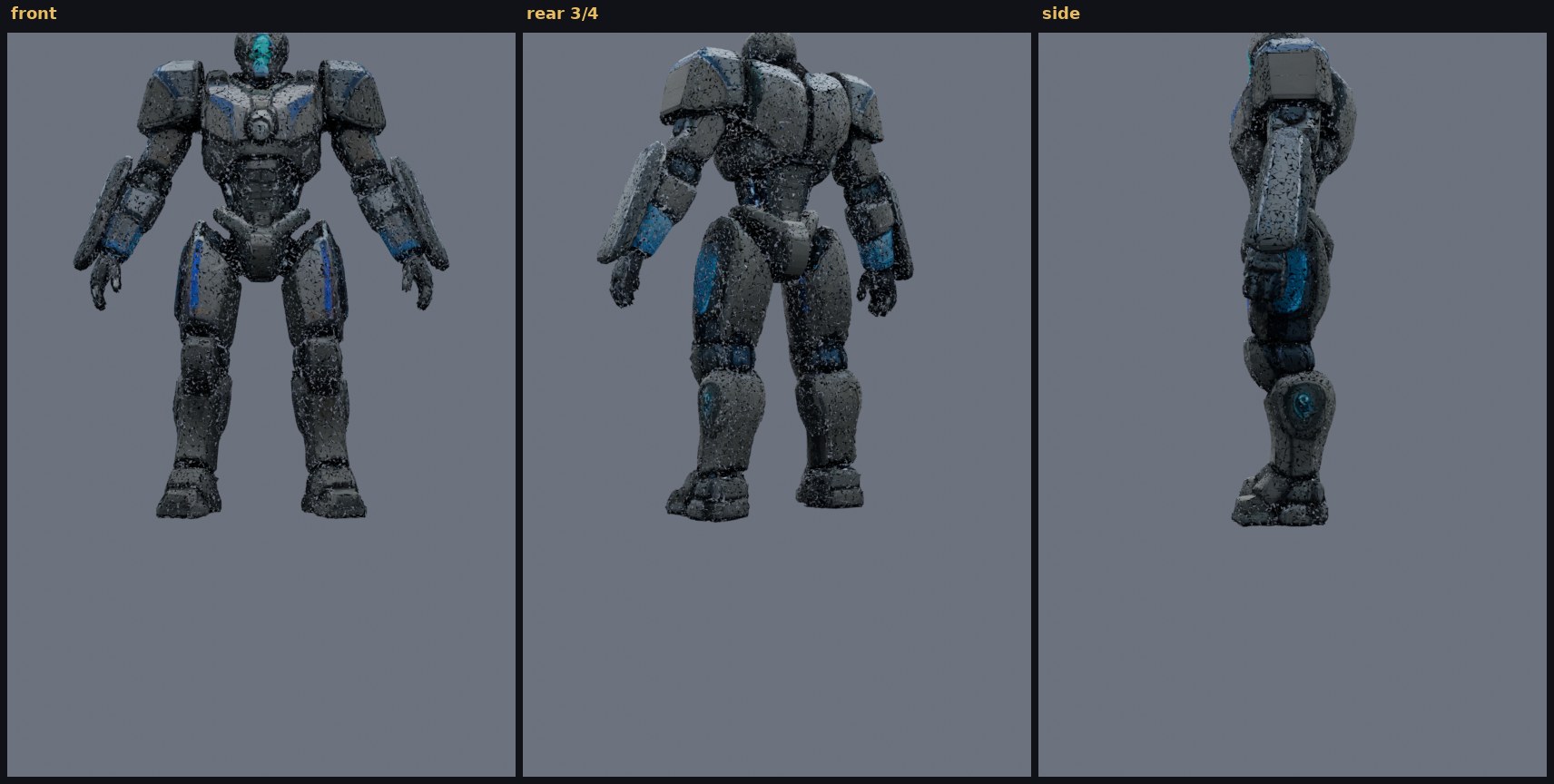
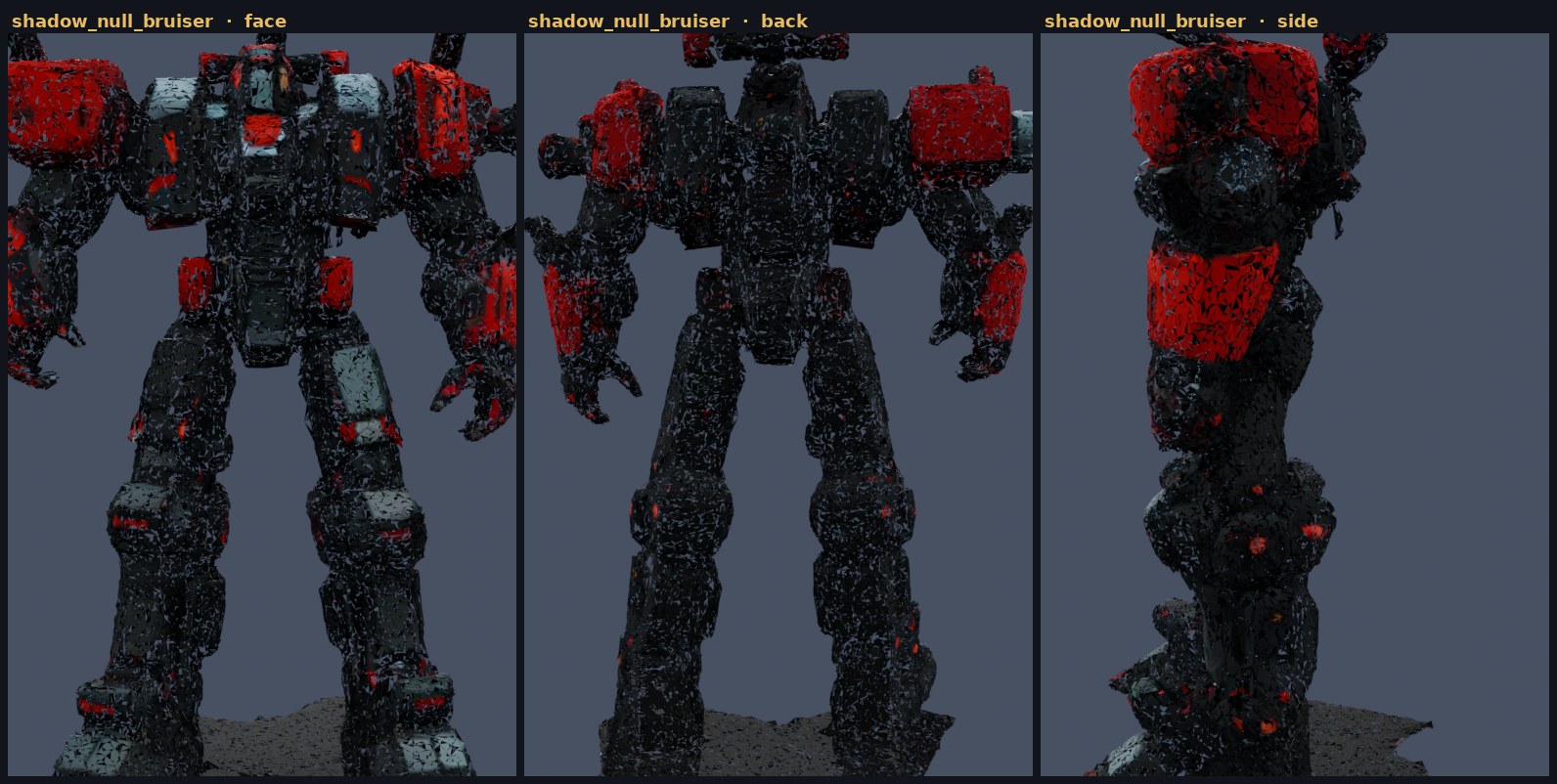
- Texture repair exists but is not yet the public source — the cast-wide med5 proof removes albedo speckle without changing mesh, skin, or accessors. The old contact sheets and public GLBs must be replaced from that reviewed output rather than described as the current result.
- spurs_scout_drone needs a redo — the salvaged pre-OOM forge produced a melted, mis-posed crouch, not a clean biped; it is not shown above as a positive example and should not be treated as representative of the method.
- Surface and motion promotion are separate — the Mech745 static pilot is hash-locked with zero connected-surface boundaries. The old animated assets stay labeled until the richer rig clears the live movement gates; then the accepted GLB is promoted through public R2.
- Not pilotable, no cockpit yet — task-606 (pilotable walkers) and task-607 (cockpit interiors + entry/exit animations) are still pending in the queue. What's shown here is a forged, rigged, locomotion-capable body — not yet an enterable vehicle.
Part of the model-fidelity effort. Pushed to the preview branch for on-the-go review — steer any stage and it re-runs. · 🤖 a01 convergence study → · ← back to console