a01 Composition Convergence — a Study
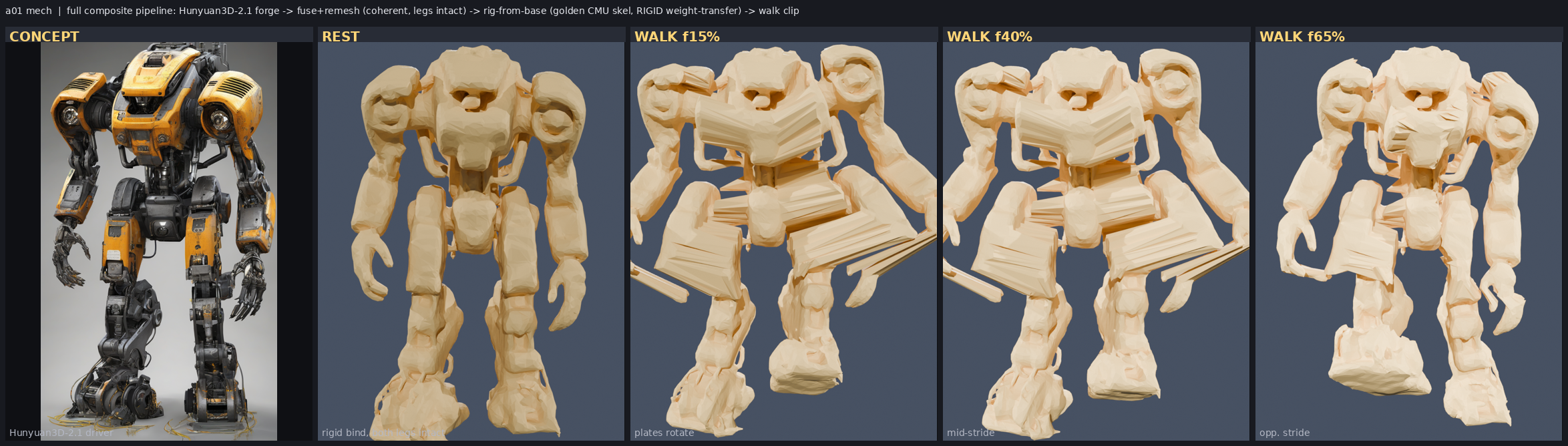
task-614).Composition-only convergence topped out at a stylized echo (~0.75 CLIP) — clean but generic, unable to reach the concept's mass. Dissecting a01 and recomposing it metric-gamed higher but looked visibly worse — an incoherent slab-pile. The breakthrough was a different shape of solution: forge a coherent whole, fuse + remesh it watertight, then rig-from-base by weight-transfer from the golden skeleton. That full pipeline is now validated end-to-end — a coherent, rigged, animated a01 at CLIP 0.769.
Current state: the shipped a01 stays the clean chunky Quaternius; the fuse → rig pipeline is validated and being polished (cut the mesh at the arm joints to kill the 7.28% tear, then texturing).
The finale — a coherent, rigged, animated a01
The journey — six stages
Each stage is a real attempt with a real result. Stages 1–4 are the dead ends that mapped the problem; stages 5–6 are the path that worked. Ratings and metrics are cited, not rounded up.
Composition-echo ceiling ~0.75
a01 as a Quaternius biped base recolored gold, with small forge-grafted parts (head / chest / shoulder-dome / claw / boot) seated on top. Six manual iterations moved the palette, hooded head, grounded boots and clawed hands toward the concept — a real but limited gain. It stays clean but generic: the signature huge gold shoulder domes and the hunched, top-heavy mass never land, because the base is one shared-surface mesh with a fixed pose. This is a ceiling of the method, not a tuning miss. Full stage-1 study below ↓
Dissect → compose incoherent
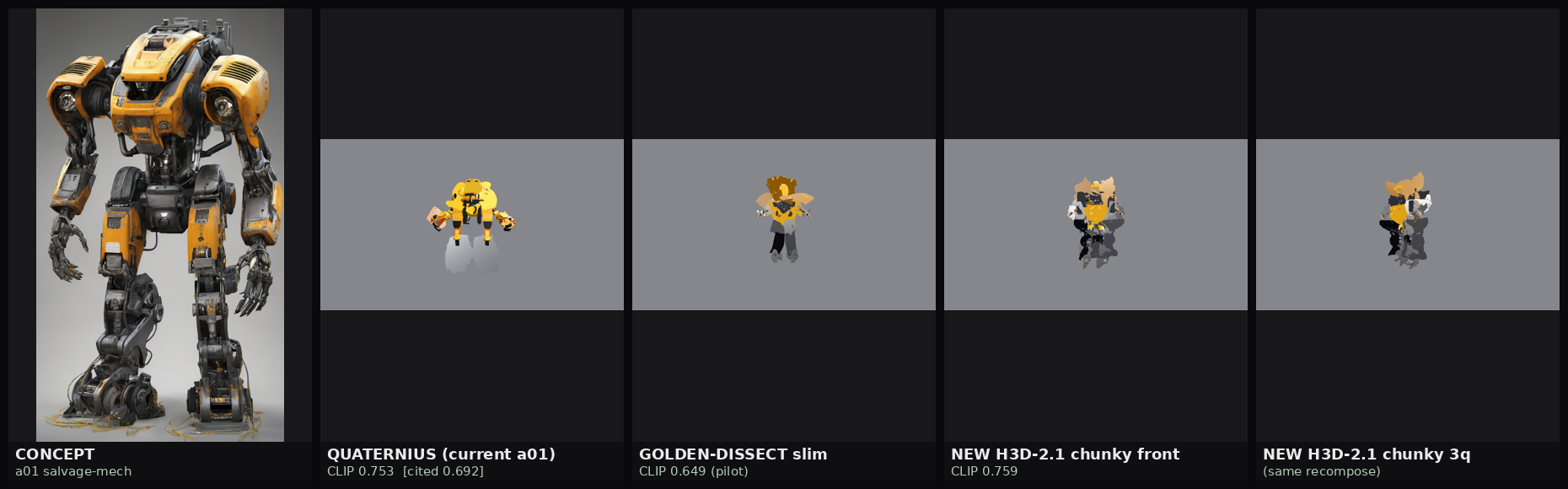
Broke a01 into parts and recomposed them on the base skeleton. Result: a slab-pile — broken legs, seam gaps, floating blocks. It metric-gamed HIGHER on CLIP but looked visibly worse. Verdict: dissect → compose fails for mechs — a coherent pre-rigged mech beats a modular slab-pile at the same score.
Golden-frame (slim base + dissected armor) regressed 0.649
Fit dissected a01 armor onto the slim golden body. Regressed to slim / ragged, CLIP 0.649. Lesson: dissecting an existing model only yields what the source already has — you cannot dissect mass that was never in the source.
Forge + multi-view tests source-bound
The forge was never the bottleneck. Multi-view generation (zero123plus's 6 views) is good and consistent — it solves single-view hallucination — but the reconstructor resolution blobs detail: InstantMesh's low-res LRM smooths everything to a soft blob (CLIP 0.698, mitten hands, no panel lines). Single-view Hunyuan stays crispest at 0.768; the new H3D-2.1 chunky forge holds crispness at 0.759. Crispness needs a higher-res reconstructor, not more views.
Fuse + remesh validated
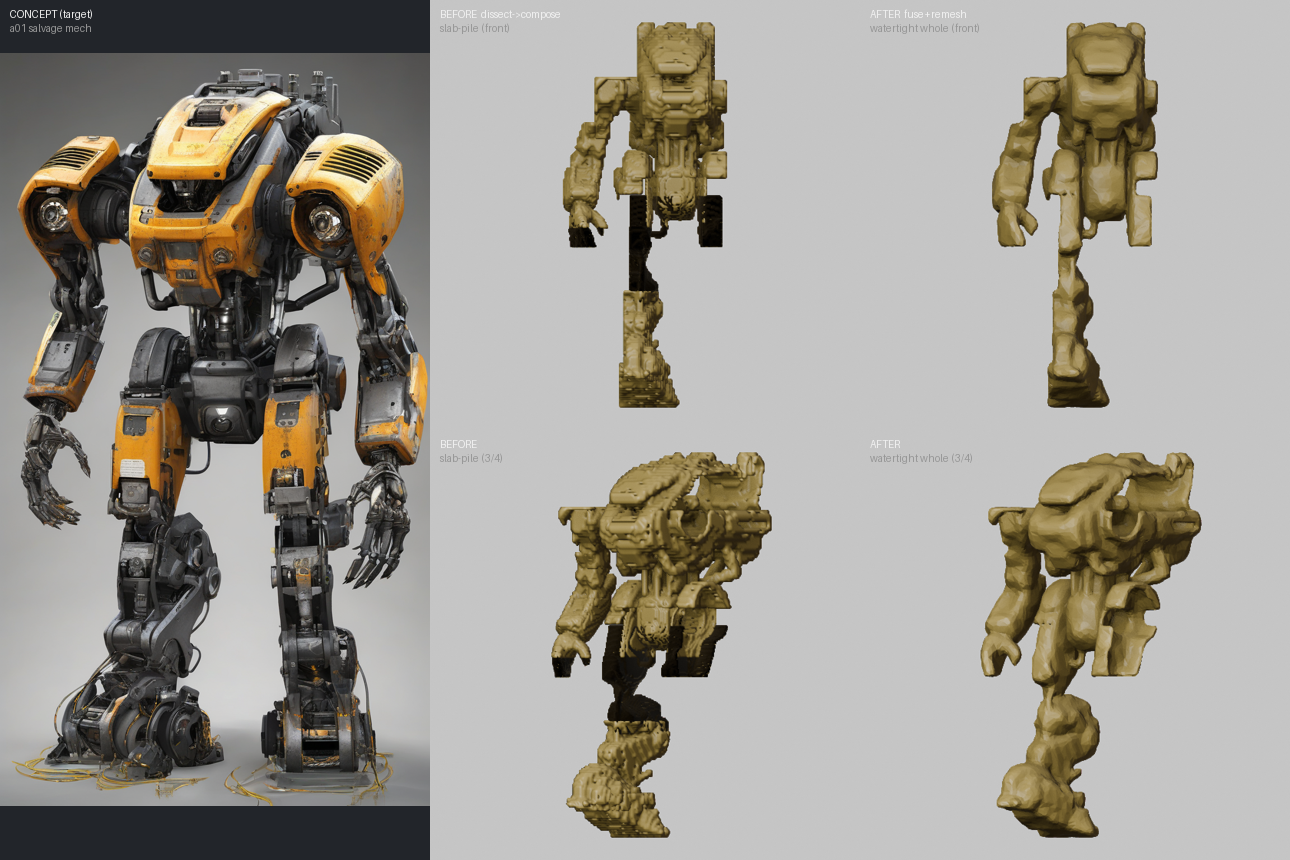
Boolean-union + remesh fuses the composite into ONE coherent watertight whole — this fixes the slab-pile: broken legs and floating blocks become a single closed body. Cost: the surface is smoother (remesh softens panel detail), it collapses to a single material, and it must be re-rigged — but re-rig is CHEAP via weight-transfer from the golden base. Two confirmed limits: a voxel union only merges geometry that touches (it won't bridge a genuine void), and it doesn't fix bad source proportions — so it needs a good, well-proportioned, mostly-touching source.
Full pipeline validated end-to-end
The whole chain in one pass: Hunyuan3D-2.1 forge (octree 384, 50 steps, ~60s on the 5090 → 420k-vert mesh, 17 components, legs intact) → fuse+remesh (detail 200 → 40k faces, 0 holes, legs verified intact) → rig-from-base (fit the golden CMU skeleton by bbox match, scale 0.687; rigid weight-transfer, each vertex to its single nearest major bone) → animate the base's walk clip. Result: coherent, rigged, animated a01, CLIP 0.769 — see the finale above. The forge is model-agnostic (2.1 on the 5090, 2.0 as a low-mem fallback; downstream never changes). Remaining levers: cut the mesh at the arm joints (the measured 7.28% tear), then texturing; a crispness upgrade awaits a higher-res TRELLIS reconstructor (built on the 5090, pending a gated aux model).
Stage 1 in depth — the composition-echo study
The origin of the arc, kept in full because it is what proved composition-only convergence has a hard ceiling —
and told the pipeline when to stop nudging and start re-forging (stages 2–6). a01 here is a Quaternius
mike biped-mech base, recolored by the a01_salvage preset, with five small forge-grafted
a01 parts. The only convergence levers are per-part scale / rot / pos, base
proportions, and gold material values — the base body mesh itself cannot be reshaped. Each iteration edited the
manifest, re-rendered front + three-quarter in a neutral grey studio (godot4 --rendering-driver opengl3,
matching the concept's lighting), and scored the result against the target by region.
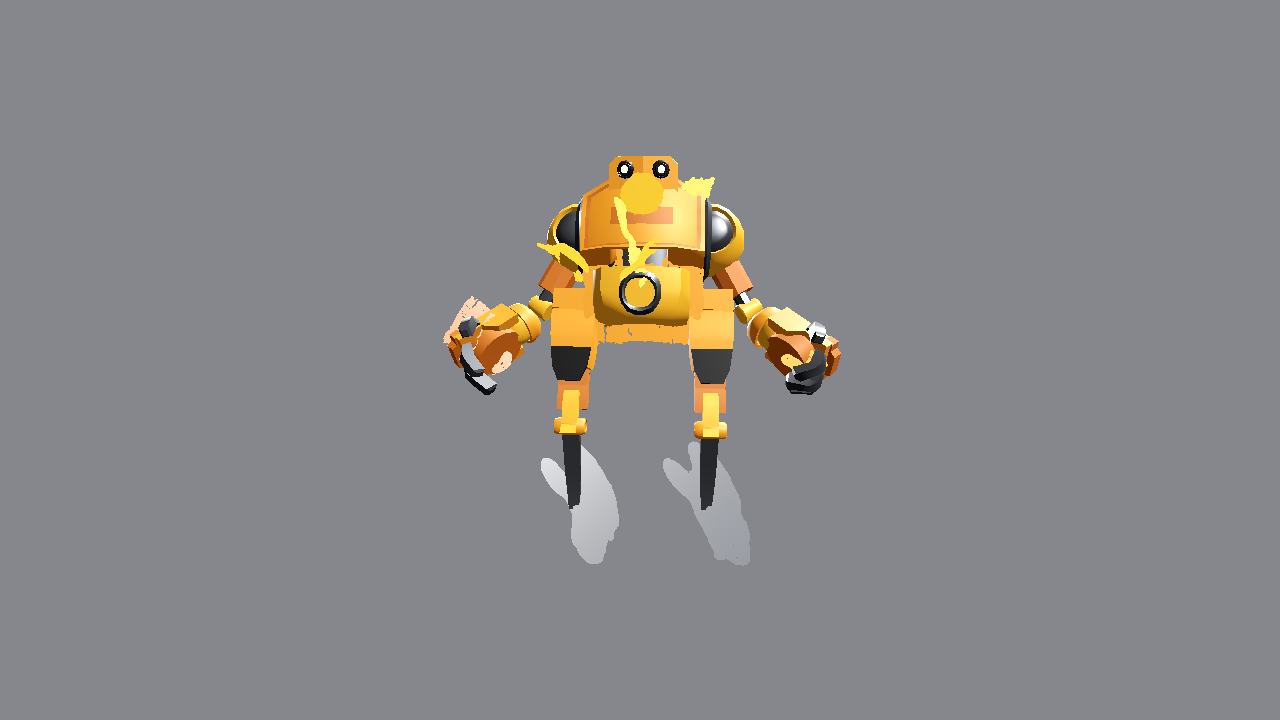 iter0 — baseline
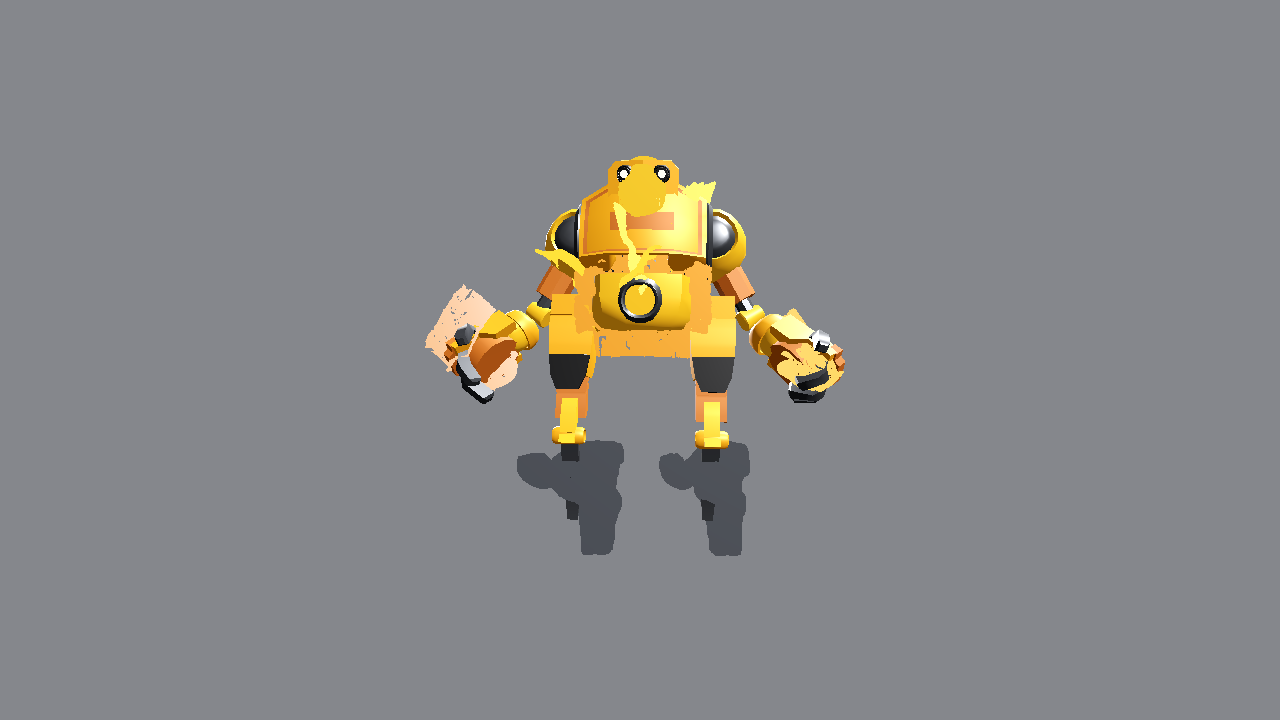 iter5 — final
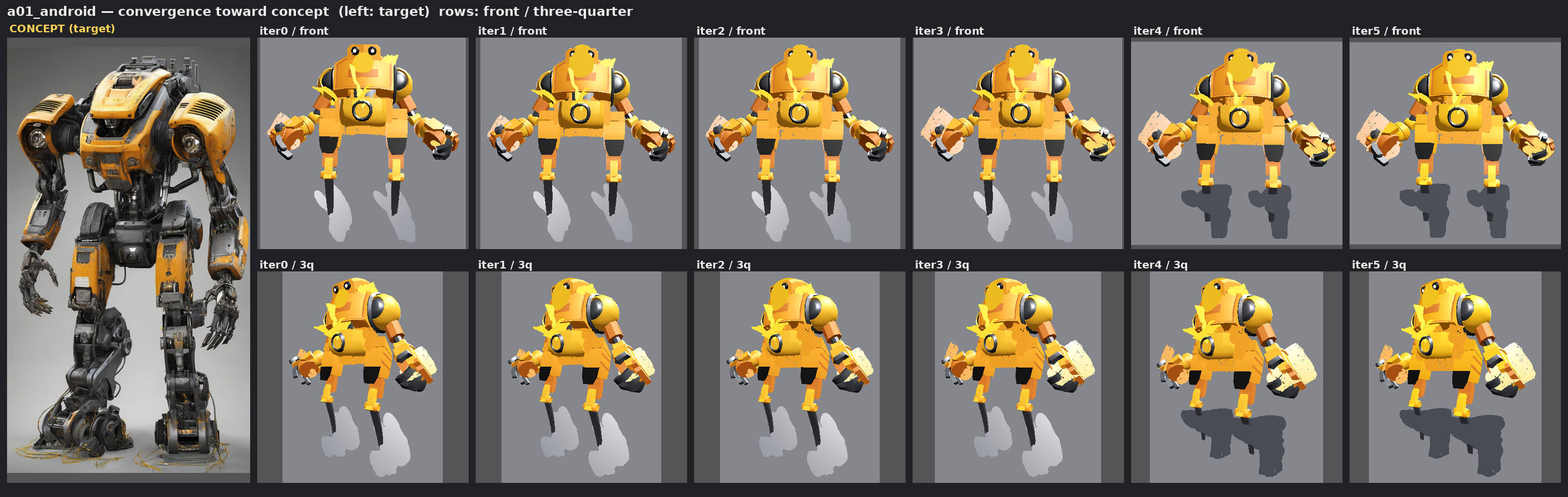
Before / after, front. The head reads as a gold hood rather than a flat box with googly eyes; the feet are grounded boots rather than thin spikes; the gold is brighter and closer to the concept's construction-yellow. The wide upright biped proportions are unchanged.
Per-iteration change log
iter0 — baseline (composition as-is)
Rendered the manifest unchanged. Gold hue already close, but: head is a round box with two googly eyes and a stray spike; shoulders read as small dark caps, not the concept's clean domes; torso is all-gold (no dark core); arms short & chunky; feet are thin black spikes half-underground; stance upright and even. Starting point: a generic recolored biped.
iter1 — head
Seated the head chunk as a forward crest. An aggressive cant (scale 4.6 / 18°) drooped over the face — a defect; landed on scale 4.4, pos [0,0.16,0.02], rot [6,0,0]. The head now reads as a rounded gold hood over the brow, more top-heavy. Still not a sharp angular crest, and mike's two round eyes still show.
iter2 — torso
Enlarging the shoulder-dome & chest grafts regressed — the a01 grafts are jagged forge chunks, so scaling them made spiky gold wings, not domes. Reverted; kept a modest chest nudge (scale 5.2→5.7) for a fuller central plate. Constraint found: a matmap probe showed mike's whole body is one mesh with six shared surfaces — the dark shoulder caps share the "Black" surface with the shins, so the concept's gold-shoulders / dark-legs split and its dark chest core cannot be recolored independently.
iter3 — arms
Enlarged the claw grafts (scale 3.2→4.2) to emphasize the skeletal hands. Arm length can't change (fixed by mike). Claws are more prominent (good), but they stay gold (the graft is unnamed and picks up the gold fallback, not the concept's dark metal), and one claw shows a pale-facing artifact from a bad normal on the chunk.
iter4 — feet
Baseline boots sat half-underground as thin spikes. Landed on scale 4.5, rot [-90,0,0] (lay the tall chunk flat/forward), pos [0,-0.12,0.12] — a bulkier mass at the foot. Ground shadows go from slivers to broad boot shapes. The single biggest silhouette gain — the stance reads grounded and boot-like. Still not detailed treads, and dark-on-dark so subtle in render.
iter5 — proportions + gold material + cleanup
Bumped gold saturation toward the concept's bright construction-yellow (Main [0.8,0.45,0.09]→[0.86,0.52,0.06], etc.), reduced the head stray chunk (scale 4.4→4.1), and split the mirrored claw entry (did not fix the pale facing; kept, no regression). Gold hue is now the closest it has been to the concept.
Per-region match vs. concept
Ratings are a judgement call against the target render, not a metric — but they are deliberately unflattering where the method fell short.
| Region | Match | Notes |
|---|---|---|
| Head | iter0 flat box + spike + googly eyes → gold hooded dome, more top-heavy. Not the sharp angular crest; still shows mike's round eyes + a minor stray chunk. | |
| Torso | Solid bright-gold plate — close on colour/plating. Misses the concept's exposed DARK mechanical core (can't isolate it in the shared mesh). | |
| Shoulders | The concept's SIGNATURE huge gold domes never landed — enlarging the jagged graft made spiky wings (reverted); the clean dark caps are mike's own mesh sharing the "Black" surface with the shins, so they can't be gold-ised without golding the legs. Weakest region. | |
| Arms | Prominent clawed gauntlets (good), but arm length is fixed by mike, claws are gold not dark, and one claw has a pale-facing artifact. | |
| Feet | Biggest gain — thin spikes → grounded bulky boots (broad boot-shaped shadows). Still not detailed treads, and dark-on-dark subtle. | |
| Colour | Bright construction-yellow gold reads clearly like the concept. Best-matching axis. | |
| Stance / proportions | Upright even biped vs. the concept's hunched, top-heavy, gorilla-like hulk — unchanged (base pose is fixed). |
Why composition-only hit a ceiling
Stage 1's convergence is real but modest — a stylized gold salvage-mech echo, not a close likeness. The failure is not tuning; it is structural. Three concrete reasons composition-only tops out on a complex mech:
- One shared-surface base mesh blocks per-region recolour. mike's whole body is a single mesh with six shared material surfaces. The dark shoulder caps share the "Black" surface with the shins — so the concept's gold-shoulders / dark-legs split and its dark chest core cannot be painted independently. Recolouring one region recolours the other.
- Jagged forge grafts can't become clean domes. The a01 parts are irregular forge chunks. Scaling the shoulder graft up to chase the concept's massive clean domes produced spiky wings, not domes (iter2 regressed and was reverted). The geometry to make that silhouette simply isn't in the part.
- The base pose is fixed. The concept is a hunched, top-heavy, gorilla-like hulk; the base is an upright, even, wide-torso biped. No manifest lever reshapes the body or re-poses it, so the defining proportions never move.
That is exactly why the arc moved off composition. Real convergence on a mech like this needs a coherent
forged whole, fused and re-rigged — the re-forge action that task-614's automated pipeline is
scoped to trigger when composition-only stalls. Stages 5–6 above are that path, now validated end-to-end. This
study is what tells the pipeline when to stop nudging and start re-forging.
The shipped a01 in the game is still the clean chunky Quaternius composition. The fuse → rig → animate pipeline is validated (coherent, rigged, animated, CLIP 0.769) and being polished, not yet shipped: next is cutting the mesh at the arm joints to remove the 7.28% joint tear, then texturing. The crispness upgrade (higher-res TRELLIS) is pending a gated auxiliary model.
← full pipeline · eye refinement study → · golden-body measurements → · home →